


A Plain-Language Synthesis of Three Papers Testing the ECDO Hypothesis
These three papers address a single question from distinct complementary angles: if Earth has undergone large, rapid reorientations of its inertial geometry, as proposed by Roger Cunningham (@EthicalSkeptic) in his 2023/2024 ECDO (Exothermic Core–Mantle Decoupling) hypothesis, should there be coherent, testable signatures left behind in the planet’s structure, surface evolution, and patterns of human occupation?
Rather than attempting to prove a specific historical event, the papers ask a more constrained and scientifically tractable question: does a physically defined, planet-scale reorientation framework generate observable, non-random patterns across independent datasets that span the full sequence of predicted effects? Taken together, they test the ECDO hypothesis from initiation, through surface response, to long-term recovery.
1. Planetary-Scale Stress: Is There Evidence for a Global Shear Framework?
The first paper examines whether Earth’s surface and lithosphere preserve evidence of a long-wavelength, planet-scale stress geometry that cannot be fully explained by local tectonic processes alone.
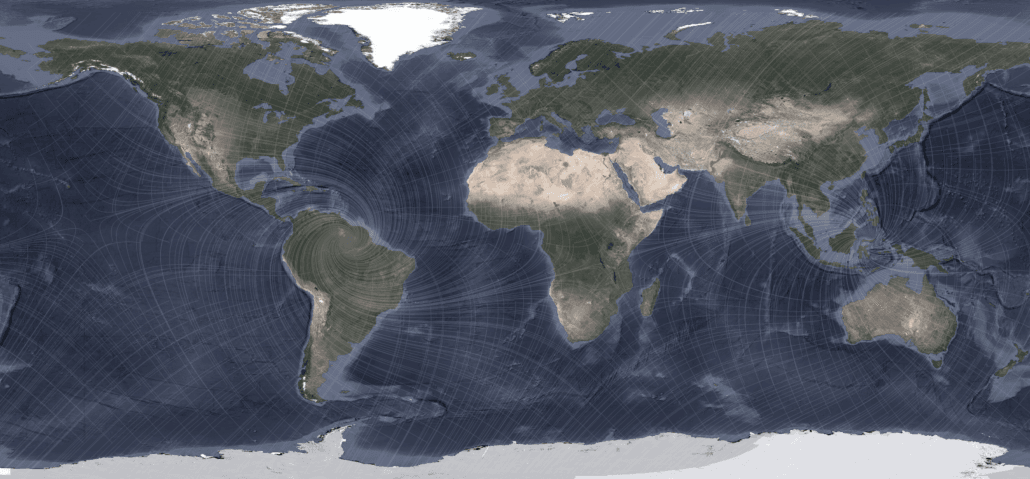
Many of Earth’s largest geological features, including curved mountain belts, sweeping sedimentary arcs, rift systems, and bathymetric arcs, display smooth, large-radius curvature across thousands of kilometers. Conventional geology explains each case locally through plate interactions, rifting, erosion, or sediment transport. While these explanations are valid, the recurrence of similar geometry across unrelated tectonic settings raises the possibility of an organizing influence operating at planetary scale.
To test this idea, the study constructs an idealized global shear field derived from a prescribed true-polar-wander–like rotation. Importantly, this field is generated analytically and is not tuned to geological observations. The test is not whether the model perfectly matches modern stress orientations, but whether the pattern of agreement and disagreement is itself spatially organized.
Using stress-orientation data from the World Stress Map and permutation-based spatial statistics, the study finds that misfit between observed stresses and the modeled shear field is not randomly distributed. Instead, it forms coherent geographic clusters across scales ranging from hundreds to several thousand kilometers. This demonstrates that the model captures a meaningful long-wavelength structure even where average misfit metrics are non-diagnostic.
Qualitative comparisons reinforce this result. The same shear geometry aligns with major sedimentary arcs in the southeastern United States, the curvature of the Himalaya, segmentation of the Mid-Atlantic Ridge, the South Indian Ocean tectonic arc, and multiple glacially sculpted landscapes. These features span different tectonic regimes and geological ages, suggesting a persistent stress framework rather than a single localized cause.
This paper therefore addresses the initiation stage of the ECDO sequence by establishing that a planet-scale shear geometry of the expected form is both mathematically well defined and empirically detectable.
2. Surface Consequences: How Would Rapid Reorientation Reshape Sea Level and Habitability?
The second paper turns from stress geometry to surface response, asking what a rapid inertial reorientation would do to Earth’s equilibrium sea level and whether this response left a detectable imprint on early human geography.
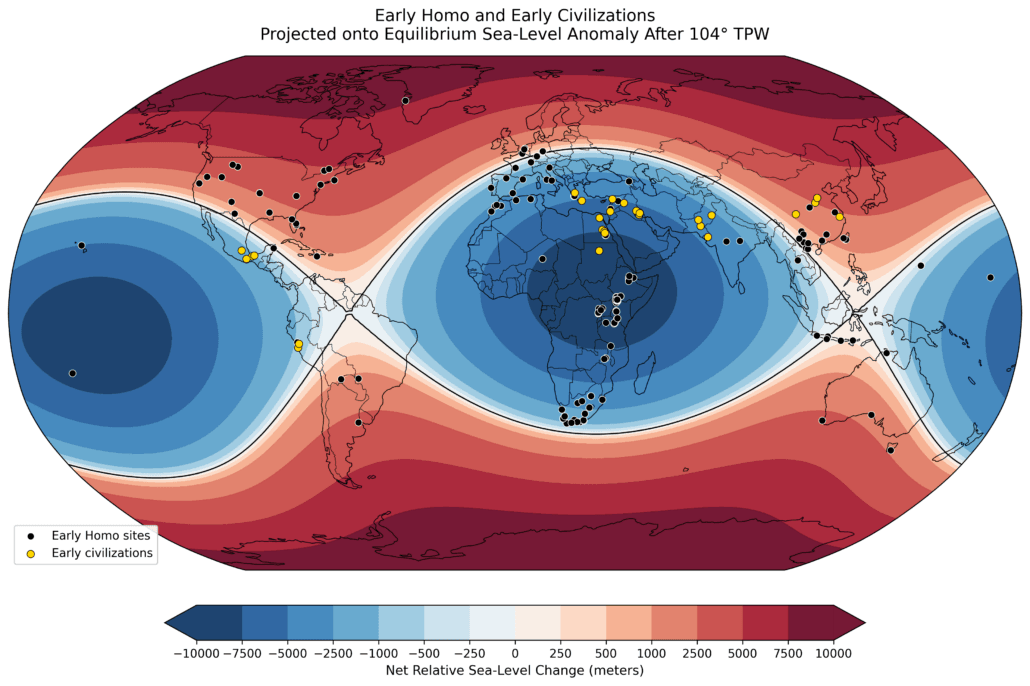
A rapid true polar wander alters the centrifugal potential of the planet. Even without any change in ocean volume, this reshapes where sea level wants to sit relative to the continents. Some regions experience long-term relative emergence, while others undergo relative submergence. The boundary between these regimes is a physically defined equilibrium margin rather than a coastline.
The study computes this equilibrium sea-level geometry for a 104-degree TPW-like rotation and measures the distance of early Homo fossil sites from the resulting margin. A strong monotonic relationship emerges: older sites lie systematically farther from the margin, while younger sites cluster progressively closer to it. Monte Carlo null tests show that this pattern is extremely unlikely to arise from random spatial placement.
To move beyond a static scenario, the paper models viscoelastic relaxation, representing the gradual adjustment of Earth’s shape toward a new equilibrium following rapid reorientation. As the equilibrium margin migrates over time, the age–distance relationship persists. Early hominin occupations preferentially align with regions undergoing progressive emergence rather than with long-term submerged or unstable interiors.
Early civilizations show a contrasting pattern. They cluster in regions that remain above sea level throughout the relaxation sequence, consistent with the greater environmental stability required for complex societies.
This paper addresses the middle stage of the ECDO sequence by testing the global surface and habitability consequences of inertial reorganization.
3. The Return Phase: Was Earth’s Recovery Smooth or Episodic?
The third paper examines the final stage of the sequence: how Earth returns toward equilibrium after large-scale disturbance, and whether that return is best described as smooth or episodic.
Classical geophysical models typically assume continuous, gradual relaxation governed by viscoelastic timescales. However, geological and paleoclimate records frequently show bursts of rapid change separated by quieter intervals. The study compares a smooth continuous return model with an event-guided model in which most adjustment occurs during discrete episodes derived independently from the geological record.
Rather than relying solely on geophysical proxies, the paper uses archaeological site distributions as an external diagnostic. If surface stability matters, occupied sites should preferentially cluster in regions that remain stable across modeled return phases, and their timing should not align randomly with adjustment episodes.
The results show that both early Homo and early civilization sites are non-random with respect to modeled stability fields. Spatial and temporal null tests indicate statistically significant alignment with the event-guided return model. Crucially, model parameters are fixed a priori and not tuned to archaeological data.
This paper addresses the return phase of the ECDO sequence by testing whether recovery dynamics inferred from geophysics are consistent with independent records of long-term human occupation.
3.1 The Question of the Ice
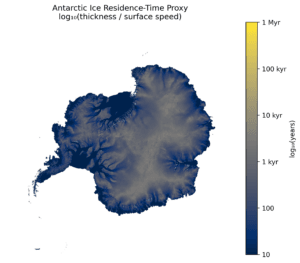
Antarctic ice residence-time proxy, expressed as log10(H/u) in years. Long residence times are concentrated in the interior of East Antarctica, while West Antarctica is characterized by shorter evacuation timescales.
One of the observations emerging from the viscoelastic return modelling concerns the fate of ice on Greenland and Antarctica. In these models, bedrock topography (though not necessarily ice surfaces) would have been extensively inundated by equilibrium sea levels during ECDO State 2, and again at several intervals during the return toward State 1.
Recent work on Greenland increasingly supports substantial ice loss across the Bølling–Allerød and Younger Dryas. Multiple studies now suggest that on the order of 30–35 % of Greenland’s ice volume was lost during this interval, with perhaps 30–50 % of the present ice sheet having formed since the Younger Dryas termination.
Antarctica presents a more difficult problem. While deep ice cores demonstrate the existence of very old ice at a handful of interior sites, they sample vanishingly small areas and say little about the volumetric age structure of the ice sheet as a whole. At present, we do not have a clear answer to a simple question: how much of Antarctica’s ice could not plausibly have survived major late-glacial disruption?
The current state of the art is represented by Bingham et al.’s AntArchitecture project, which synthesises radar stratigraphy, ice cores, and modelling to construct a continent-scale Antarctic age-depth framework. This work is foundational, but it also highlights the difficulty of translating sparse stratigraphic constraints into robust volumetric estimates.
For lack of a clearly articulated estimate in the existing literature, I’ve attempted to reach an estimate based on available data. Rather than attempting to assign absolute ages, we ask, given present-day ice thickness and flow alone, what fraction of Antarctic ice volume is dynamically capable of persisting beyond millennial to multi-millennial timescales?
The result is not an age map in the traditional sense, but a physically interpretable constraint on how much Antarctic ice could be old, and how much almost certainly is not.
Applying a dynamics-based residence-time framework to modern Antarctic thickness and velocity fields, the results suggest that only a small fraction of the ice sheet is plausibly long-lived in a volumetric sense. While interior East Antarctica clearly hosts regions capable of preserving ice over multi-glacial timescales, our conservative estimates indicate that only ~1 % of total Antarctic ice volume is dynamically constrained to exceed ~10 kyr residence times, with uncertainty bounds of roughly 0.6–2.5 %. West Antarctica, by contrast, exhibits steep dynamical gradients, with fast flow sharply limiting long-term ice persistence. These results do not preclude the existence of very old ice, but they imply that such ice occupies a vanishingly small fraction of the ice sheet by volume, and that much of Antarctica’s ice cover is dynamically young or frequently renewed.
Claims that this conflicts with observational data misunderstand what the observations actually show. Ice cores and radar stratigraphy demonstrate that very old ice exists in Antarctica – they do not show that such ice is common by volume. Those old cores sit at exceptional interior dome sites with thick ice and near-zero flow, precisely the regions identified as long-lived in the analysis. What the results contradict is the casual assumption that “old ice” represents a large fraction of the ice sheet. It doesn’t.
Full sources, methodology and results:
Draft Paper | Code & Data
4. What the Three Papers Show Together
Individually, each paper tests a different consequence of large-scale inertial reorganization. Together, they form a coherent, end-to-end evaluation of the ECDO hypothesis:
- A mathematically defined planetary shear framework exists and leaves detectable spatial signatures.
- Rapid reorientation produces global sea-level geometry that correlates strongly with early human dispersal.
- The long-term return toward equilibrium is better described as episodic rather than smoothly continuous, consistent with independent archaeological evidence.
None of the papers argue for direct causation between geophysical events and human behavior. Instead, they test whether Earth’s physical reorganization imposes persistent boundary conditions within which biological and cultural processes unfold.
Taken together, the three studies demonstrate that the ECDO framework is not merely speculative. It is empirically testable across planetary stress geometry, surface evolution, and long-term habitability, using independent datasets and explicit statistical controls.
5. Statistical Summary
Large-scale organisation in Earth systems is frequently inferred from geometry before it is demonstrated statistically. Sweeping arcs, basin chains, coherent stress orientations, and geographically persistent zones of stability recur across tectonic, geomorphic, and sedimentary contexts. Yet when these patterns are tested using conventional global-average metrics—mean angular misfit, global correlation coefficients, or least-squares residuals—they often fail to outperform null models. This mismatch between visual coherence and scalar statistical weakness has contributed to a long-standing methodological tension. Either the apparent organisation is dismissed as coincidental, or the statistical tests are judged ill-suited to the phenomenon under investigation. The present synthesis adopts a third position: that the dominant signal of long-wavelength organisation is not improved global alignment, but spatial structure itself.
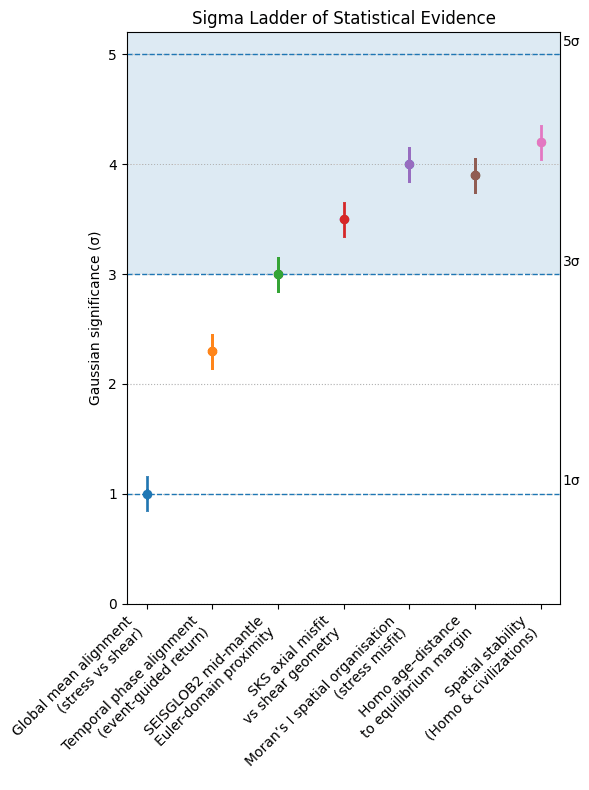
Sigma ladder of statistical evidence across independent datasets. Discrete rungs show the Gaussian-equivalent significance (σ) of each statistical test, ordered horizontally by diagnostic type rather than implying continuity. Dashed horizontal lines mark conventional 1σ, 3σ, and 5σ reference levels, while the shaded region highlights the ≥3σ regime commonly interpreted as strong evidence in the physical sciences. Global mean alignment metrics between modeled shear geometry and observed stress orientations remain ≤1σ and are statistically non-diagnostic. Temporal phase alignment with event-guided return models reaches ~2–3σ, indicating a consistent but secondary signal. In contrast, multiple independent measures of spatial organisation—including permutation-based Moran’s I clustering of stress–misfit fields, axial misfit between SKS anisotropy and shear geometry, depth-localised associations in mid-mantle tomography, equilibrium sea-level relationships with early Homo site ages, and spatial stability metrics for both early Homo and early civilizations—cluster robustly in the ~3–5σ range. The ladder illustrates a systematic pattern: scalar averages are weak, whereas spatial and spatiotemporal organisation repeatedly attains multi-sigma significance across geophysical and archaeological datasets, consistent with a persistent long-wavelength geometric framework.
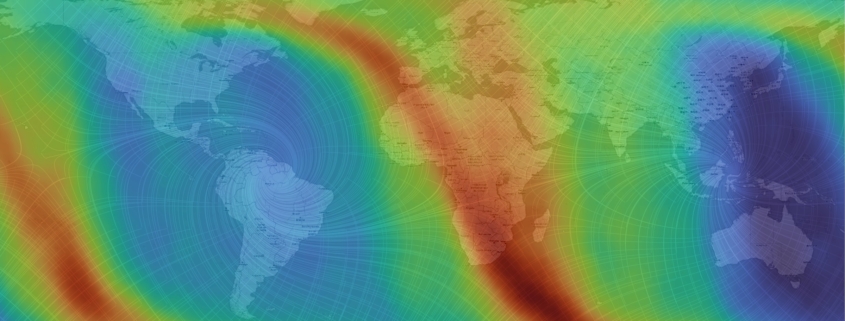
If the Earth has rapidly reoriented in the past, the resulting inertial mismatch between the solid Earth and its fluid envelopes would drive high-velocity surface transport. The atmosphere, hydrosphere, and unconsolidated materials would be mobilised along coherent trajectories dictated by the rotation geometry, producing large-scale, directionally organised flow fields. These flows would imprint persistent anisotropic signatures into the geological and geomorphological record, expressed through aligned erosional features, sediment transport pathways, and coherent structural overprints.

Catastrophe, in its original sense, denotes a turning point, not a failure. In far-from-equilibrium systems, such turning points are unavoidable. The choice is not between change and stability, but between managed inheritance and abrupt transmission. Noise is not the adversary of order. Unacknowledged drift is.

There are periods in which societies attempt to recover order not through passion or ideology, but through calculation. The Technocracy Movement of the early twentieth century arose during one such period. It promised that, if only production and administration were entrusted to technical expertise rather than partisan struggle, waste and instability might give way to something more disciplined and rational.
Nature rarely gives a simple answer to a simple question, but if you ask a precise question at the right scale, she often answers very clearly.

“Proceeding along the globe due north and due south of the Great Pyramid, it has been found by a good physical geographer as well as engineer, Mr. William Petrie, that there is more earth and less sea in that meridian than in any other meridian all the equator round. Hence, therefore, the Great Pyramid’s meridian is caused to be as essentially marked by nature, in a general manner, across the world from Pole to Pole.”

In a little while Einstein came from the upper floor to us, his long hair well-groomed, his face lighted up with his friendly smile. He started to move a chair with a straight high upholstered back, which had already drawn my attention in the modestly furnished room, and as I helped him, a help he graciously accepted, he said, “this is my Jupiter chair.”

