


“Catastrophe, in its original sense, denotes a turning point, not a failure. In far-from-equilibrium systems, such turning points are unavoidable. The choice is not between change and stability, but between managed inheritance and abrupt transmission. Noise is not the adversary of order. Unacknowledged drift is. Systems that remain adaptive are those that permit frequent, limited inheritance rather than rare, overwhelming correction. The central lesson is therefore conservative rather than radical. Stability is not preserved by denying stochasticity, nor by fetishising equilibrium. It is preserved by understanding how deviation accumulates, how it is stored, and when it must be shared. To ask when a system will break is to ask the wrong question. The more instructive inquiry is what drift is already being inherited, and what future it has already constrained.” – Inheritance Before Collapse: Stochastic Drift and the Geometry of Transformative Change
Scientific explanations often seek external causes for events. When an event seems sudden or irregular, it’s natural to think of a disturbance, like a solar outburst or cosmic encounter, that disrupts a stable world. This is understandable, as human intuition favours narrative causation, where dramatic events lead to dramatic outcomes.
Irregular phenomena in physics often arise from the internal structure of dynamical systems, not external disturbances. When governing equations allow for multiple states, metastability, or nonlinear feedback, systems can exhibit seemingly exceptional events as ordinary motions within a structured landscape. The geomagnetic field appears increasingly to belong to this class of systems.
Paleomagnetic observations show that Earth’s magnetic dipole does not remain rigidly fixed. It wanders, occasionally weakens, and at irregular intervals undergoes large excursions. These excursions, recorded in volcanic rocks and marine sediments, have often been treated as anomalies requiiring explanation by unusual external agency. The irregularity of their timing and association with a weakening field weakening encourages speculation about catastrophic triggers.
Time evolution of geomagnetic dynamical energy derived from pole motion. Energy peaks correspond closely with known geomagnetic excursions.
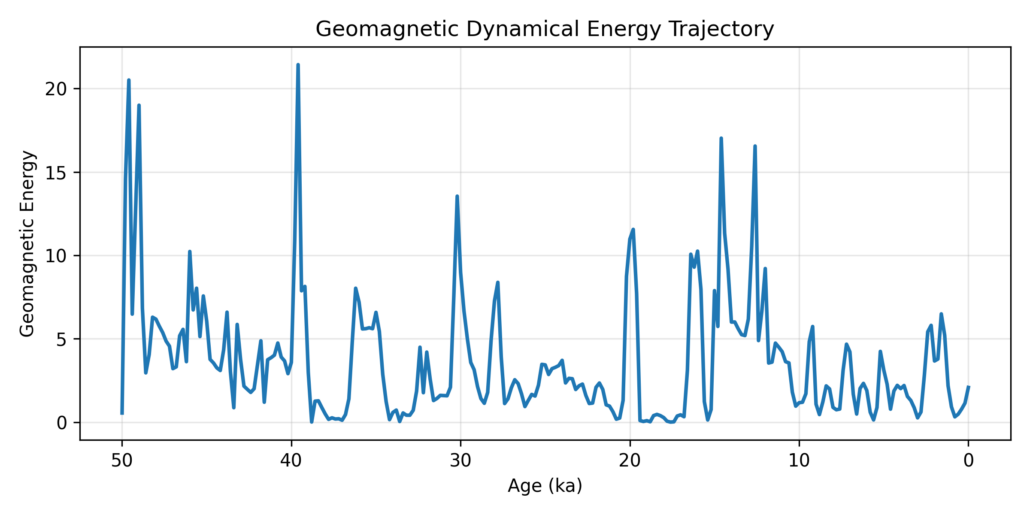
Time evolution of geomagnetic dynamical energy derived from pole motion. Energy peaks correspond closely with known geomagnetic excursions.
When the motion of the virtual geomagnetic pole is analysed as a dynamic trajectory, it resembles a weakly nonlinear oscillator. The dipole state is a metastable basin in a dynamical landscape. Within this basin, the pole moves boundedly, constrained but not rigidly confined. Large excursions occur near the basin’s boundary, near the stability threshold of the attractor. The system doesn’t need a trigger to produce excursions; they’re already present in the system’s phase space.
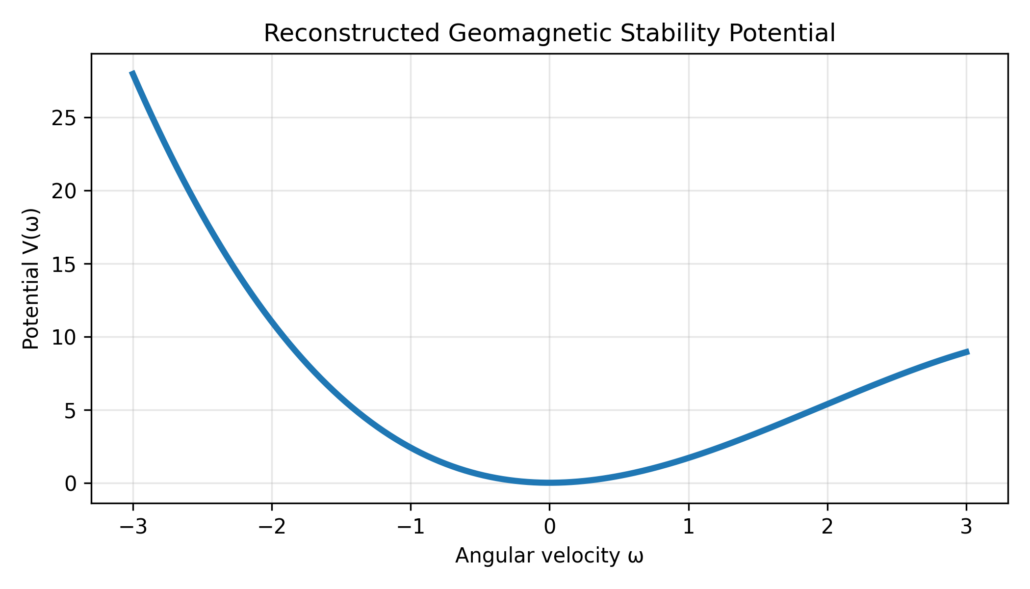
Effective dynamical potential inferred from reconstructed oscillator equations.
This interpretation shifts from event-based explanations to state-space descriptions, examining how the system evolves within its dynamical states and transitions. A geodynamo driven by convection in the electrically conducting outer core is inherently nonlinear. Rotation, buoyancy, Lorentz forces, and turbulent flow interact in a regime dominated by Coriolis dynamics. It’s surprising if such a system behaves as a rigid equilibrium perturbed only by external disturbances. The more natural expectation is that it occupies a structured attractor in phase space, with metastability, intermittency, and chaotic wandering as common features.
The reconstructed dynamics of geomagnetic pole motion are consistent with this expectation. The trajectory occupies a bounded attractor, the dipole configuration forms a local stability minimum, and excursions correspond to approaches toward the stability boundary of that basin. Such behavior is characteristic of many nonlinear systems in which coherent large-scale structures coexist with underlying turbulence.
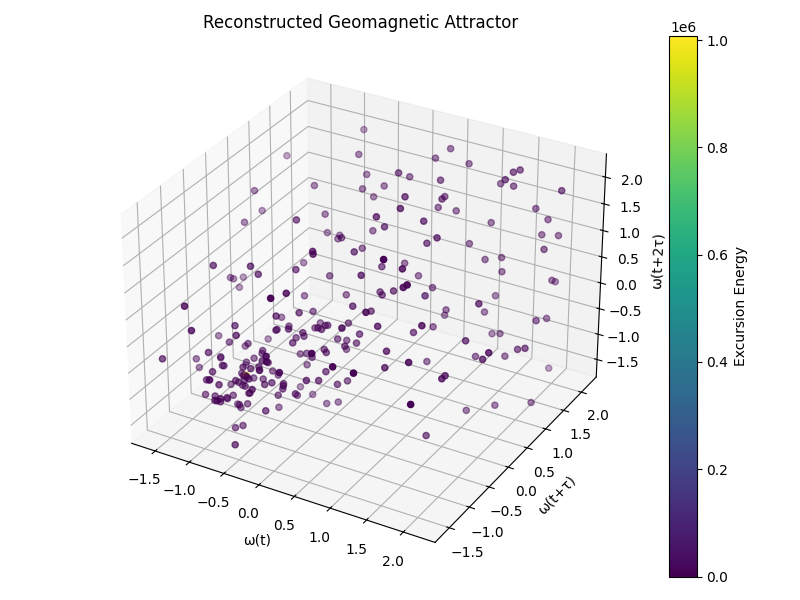
Reconstructed attractor of geomagnetic pole dynamics derived from delay embedding of the pole trajectory time series. Color indicates excursion energy.
This illuminates an otherwise puzzling feature of the paleomagnetic record: Excursions do not occur with strict periodicity, yet they are not completely random either. They appear intermittently, sometimes clustering in time. In a metastable dynamical system this pattern arises naturally. When the system’s trajectory approaches the stability boundary, excursions become more probable; when it remains deep within the basin, they are rare. The irregularity therefore reflects the geometry of the attractor rather than the arrival of external disturbances.
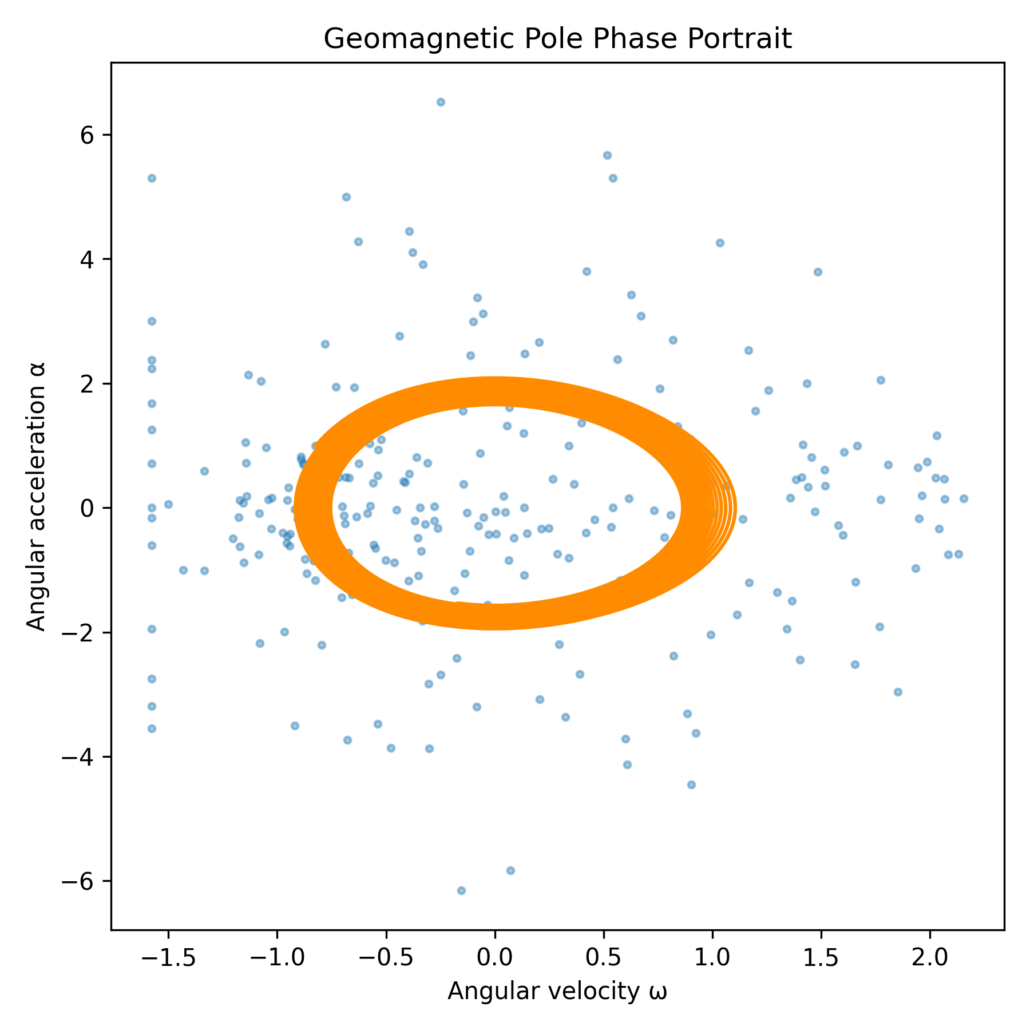
Phase diagram of geomagnetic pole motion showing angular velocity versus angular acceleration. The bounded structure indicates the presence of a metastable dipole attractor.
The geomagnetic system does not exist in isolation. The fluid core, within which the dynamo operates, is embedded in a rotating planet whose mantle provides both mechanical and thermal boundary conditions. Heterogeneities in the mantle influence heat flux at the core–mantle boundary, shaping convective patterns in the outer core. Through these boundary conditions the geodynamo inherits a degree of anisotropy relative to the mantle reference frame. This anisotropy may help explain another empirical observation: geomagnetic excursions often follow preferred geographic corridors, suggesting the existence of Earth-fixed dynamical planes along which the pole tends to rotate during large excursions. Such geometric regularities would be difficult to reconcile with purely stochastic turbulence. They instead suggest that the dynamical landscape of the geodynamo is anchored to the structure of the mantle.
The Earth system has two interacting layers: the magnetic-fluid system of the geodynamo and the rotational system of the planet. These layers are coupled through angular momentum exchange and other interactions. The geodynamo attractor thus evolves within a slowly changing rotational environment. Changes in that environment may distort the dynamical landscape, subtly altering the stability of the dipole basin and modifying the probability of excursions. Geomagnetic excursions represent the natural motion of the coupled system as it explores the possibilities available within its own geometry.
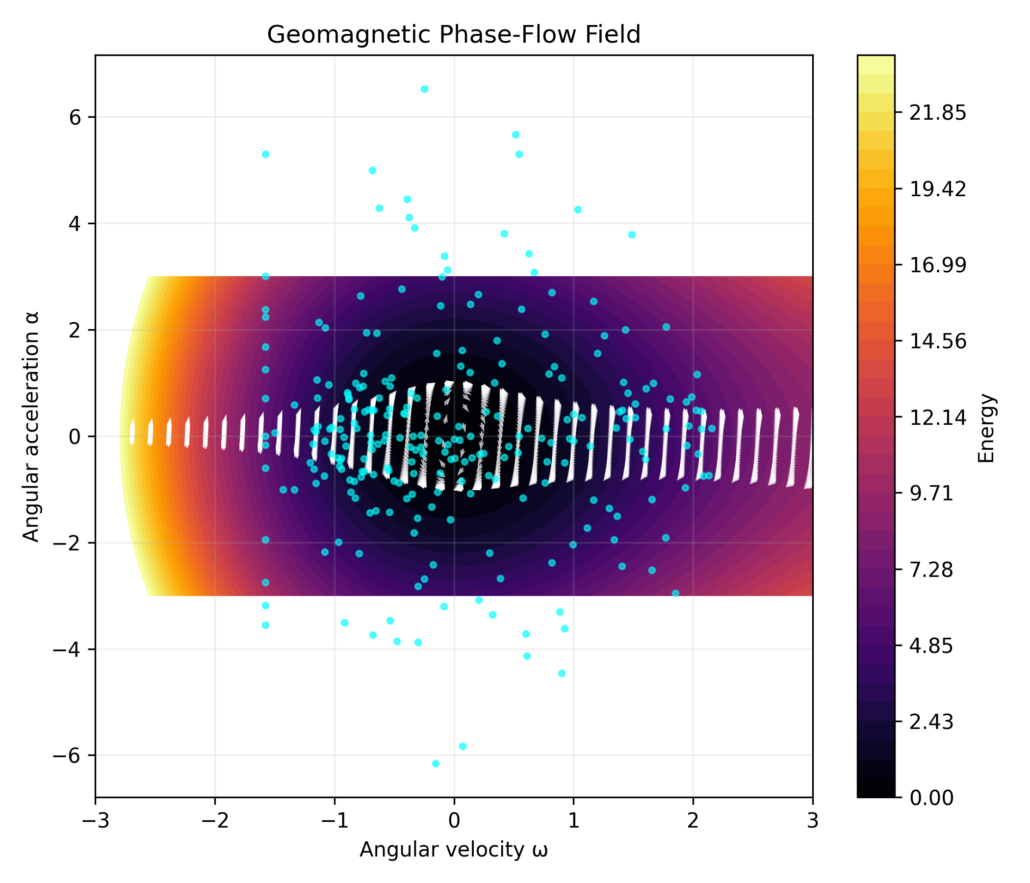
Phase flow derived from the recovered dynamical equations. Trajectories circulate within a bounded region corresponding to the dipole attractor.
As Ilya Prigogine observed in his reflections on far-from-equilibrium systems, order and disorder often arise from the internal dynamics of complex systems rather than external design. Disorder can mask an underlying structure becoming visible only when examining the system through the lens of dynamical states rather than discrete events. W.M Elsasser observed that complex natural systems often exhibit ‘creative stability’: stable configurations that can spontaneously transition. Deterministic prediction alone cannot fully understand their behaviour, as it reflects the interplay between structural constraints and the intrinsic variability of nonlinear dynamics. The geomagnetic field appears to exemplify this kind of stability. The dipole configuration persists for long periods, maintaining a recognisable structure. Yet it is not absolute. The system wanders, fluctuates, and occasionally approaches the threshold at which a large excursion becomes possible.
This doesn’t exlude external influences such as cosmic, solar or lunar variability and tidal forcing, or changes in mantle convection modulating the landscape. These influences (inclusive of the anthropic) don’t directly trigger excursions; they act as modulators, slightly reshaping the stability basin. The excursions themselves stem from the system’s inherent structure. Explanation frequently lies not in identifying the event that caused a phenomenon, so much as in understanding the geometry of possibility within which the phenomenon occurs. In observing the architecture of the dynamical landscape through which nature moves, what once appeared exceptional may prove to be entirely natural.
“An ECDO planet such as Earth is unusual in that it oscillates between two distinct rotational states—one stabilized by its magnetic field, the other governed by gyroscopic momentum. In this sense, the planet behaves like a geophysical yin and yang. This natural rhythm follows the weakening and renewal cycles of Earth’s magnetic field. When that field wanes, the stabilizing grip of the core relaxes, and the planet’s outer mass becomes more prone to decouple and settle into a purely gyroscopic balance. In geophysical terms, this may unfold as episodes of True Polar Wander—moments when Earth’s entire outer shell, both crust and mantle, abruptly pivots around the spin axis to recover gyroscopic equilibrium. Today’s weakening magnetic field and the rapid heating of the abyssal oceans and climate may therefore stand as cautionary signals, warning us to remain alert for precursors of such a reorientation—events memorialized in the flood traditions of Noah, Deucalion, and Utnapishtim.” – Exothermic Core-Mantle Decoupling–Dzhanibekov Oscillation (ECDO) Theory
Selected Further Reading
Magneto–Tectonic Displacement Events (MTDE) :
Draft Paper: https://nobulart.com/media/mtde.pdf
Code & Data: https://nobulart.com/media/mtde.zip
Inheritance Before Collapse:
Draft Paper: https://nobulart.com/media/drift.pdf
Code & Data: https://nobulart.com/media/drift.zip
Inner-Core Anisotropy:
Draft Paper: https://nobulart.com/media/inner.pdf
Code & Data: https://nobulart.com/media/inner.zip
Polar Motion Anisotropy:
Draft Paper: https://nobulart.com/media/anisotropy.pdf
Code & Data: https://nobulart.com/media/anisotropy.zip
Exothermic Core-Mantle Decoupling Oscillation (ECDO) by @EthicalSkeptic : https://theethicalskeptic.com/2024/05/23/master-exothermic-core-mantle-decoupling-dzhanibekov-oscillation-theory/
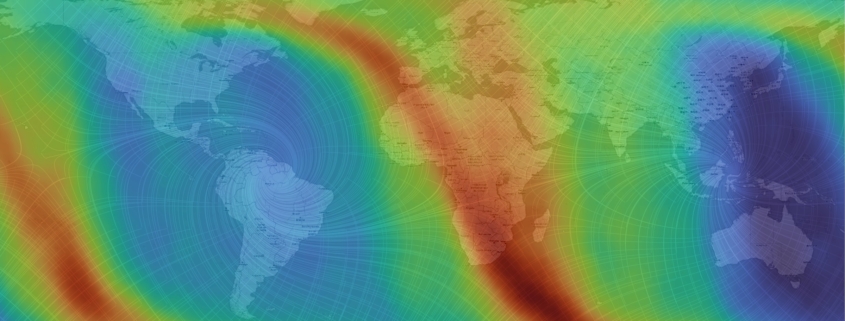
If the Earth has rapidly reoriented in the past, the resulting inertial mismatch between the solid Earth and its fluid envelopes would drive high-velocity surface transport. The atmosphere, hydrosphere, and unconsolidated materials would be mobilised along coherent trajectories dictated by the rotation geometry, producing large-scale, directionally organised flow fields. These flows would imprint persistent anisotropic signatures into the geological and geomorphological record, expressed through aligned erosional features, sediment transport pathways, and coherent structural overprints.

These three papers address a single question from distinct complementary angles: if Earth has undergone large, rapid reorientations of its inertial geometry, as proposed by the ECDO (Exothermic Core–Mantle Decoupling) hypothesis, should there be coherent, testable signatures left behind in the planet’s structure, surface evolution, and patterns of human occupation?

There are periods in which societies attempt to recover order not through passion or ideology, but through calculation. The Technocracy Movement of the early twentieth century arose during one such period. It promised that, if only production and administration were entrusted to technical expertise rather than partisan struggle, waste and instability might give way to something more disciplined and rational.
Nature rarely gives a simple answer to a simple question, but if you ask a precise question at the right scale, she often answers very clearly.

“Proceeding along the globe due north and due south of the Great Pyramid, it has been found by a good physical geographer as well as engineer, Mr. William Petrie, that there is more earth and less sea in that meridian than in any other meridian all the equator round. Hence, therefore, the Great Pyramid’s meridian is caused to be as essentially marked by nature, in a general manner, across the world from Pole to Pole.”

In a little while Einstein came from the upper floor to us, his long hair well-groomed, his face lighted up with his friendly smile. He started to move a chair with a straight high upholstered back, which had already drawn my attention in the modestly furnished room, and as I helped him, a help he graciously accepted, he said, “this is my Jupiter chair.”

