The Sibylline Star-War and Phaëthon, viewed from the standpoint of natural history
Translator’s note This is a reconstructive English rendering of the German text as OCR’d from the University of Chicago copy (kugler1927.pdf). The scan preserves Kugler’s argument and his own translations of the Sibylline verses fully. Where a Greek word is corrupt in the scan it has been restored from context; footnotes are preserved inline in brackets [n]. Bracketed editorial clarifications appear as (—trans.).
Introduction: The Stars as Warriors
The word “host” (ṣābā’) appears for the first time in the Old Testament at Gen. 2,1: “Thus were finished the heaven and the earth with all their host.” There it naturally means only the totality of the ranks of individual creatures. As a heavenly host in the proper sense the stars appear in the O.T. much later — first as objects of idolatrous worship. The homeland of this cult was Canaan, the final goal of the Israelite conquest. Hence the warning against worshipping “the sun, moon and stars, all the host of heaven” (Deut 4,19; 17,3) was only too well founded.
In the summary indictment against kings and people of Israel (II Kings 18? — (—trans.) II Kings 21,2ff.), Manasseh “erected altars to all the host of heaven” in both courts of the Temple. This cult already existed before and during the Judges’ period, though Judg. 10,6 names only the “Baals” and “Astartes.”
Moreover it follows from Judges 5,20 that the stars count as warriors: “From heaven fought the stars; from their courses they fought against Sisera.” Therein lies a fine irony: Canaan’s kings had relied on the starry host as ally, but their general’s troops found death in Kishon’s waves — swollen into a torrent by a heaven-sent storm. “Host of heaven” is therefore not merely analogous denomination; it denotes a real army.
Whence this conception? Already the orderly motion of the fixed stars and their gradations of rank (by brilliance and colour) suggest an army — as do the planets’ arbitrary wanderings, now forward, now backward, sometimes pausing like inspecting commanders. Their change of form is striking: sun and moon at horizon appear stretched out “like a wayfarer wearied by long march.” The great constellations likewise draw together toward zenith but extend enormously near horizon [2]. Still more surprising are the shooting-stars, crossing space like glowing fire-arrows; and when on cloudless nights great luminous balls descend with hissing, lightning or thunder and kindle terrestrial conflagrations, eye and ear teach the presence of terrible celestial powers.
A naive contemplation interpreted eclipses as assault by a light-hostile power, their passing as final victory of the divine luminaries over demons; comets were omen of terrible events. And this fullness of heavenly power is heightened by association with cloud-region forces — for ancients unaware of the gulf between star-world and atmosphere [4]. In Babylonian lore the storm-god Adad and sun-god Šamaš appear side by side like heroes on one stage. Cloud-eclipses ranked nearly equal to astronomical ones when rare or near full moon; halos with their mock-suns awakened warlike notions — especially with Jupiter within the ring, hostile Mars approaching: an image of siege and invasion.
These examples may suffice. They let us understand how ancients held heaven not merely alive but a stage for warfare. To such are devoted these pages: above all the war of the stars, reported in Sibylline Oracles Book V lines 512ff. and Vs 206ff., and the Alexandrian Phaëthon legend. Ours is not appreciation of poetic dress but the actual natural-historical foundation of these two monuments. Over the finale (Vs 112? — (—trans.) vs 512ff.) an impenetrable mist has hung, and Phaëthon’s secret was no more unveiled. Once the first, hardest riddle is solved we hold the key to the second.
The book delivers this emphatic lesson: ancient traditions, even in myth or legend, may not be dismissed as fantastic or senseless constructions — most of all where serious religious reports are at issue. There a resolve to strict self-criticism is salutary and timely: First weigh, then dare!
*Valkenburg (Holland), Easter 1927.* — The Author.
Part I: The So-Called “Mad Finale” of Book V — A Meaningful Nature-Poem
The close of Book V (Vs 512–531) forms the prophecy of a “war of the stars”, ending with their being hurled down and setting the earth on fire. Blass calls it a “mad finale.” Geffcken — with mathematician E. Hoppe’s agreement — declared: the vision mocks every astrological system, though operating with terms like μοῖρα; viewed from any standpoint it is complete nonsense.
Up to then no one had recognized a meaningful allegory, let alone real cosmic process. I confess my own first hasty glance fared no better. But years of deciphering Babylonian cuneiform astrology taught me that much which seems nonsensical to modern Westerners lacks neither real background nor sound logic.
The success exceeded the boldest expectation: the “mad finale” revealed itself as an elegant dressing-up of real natural events according to a perfectly unified plan — so faithfully does the poet render astronomical processes that computation fixes both the poem’s homeland and its season.
The celestial drama in outline
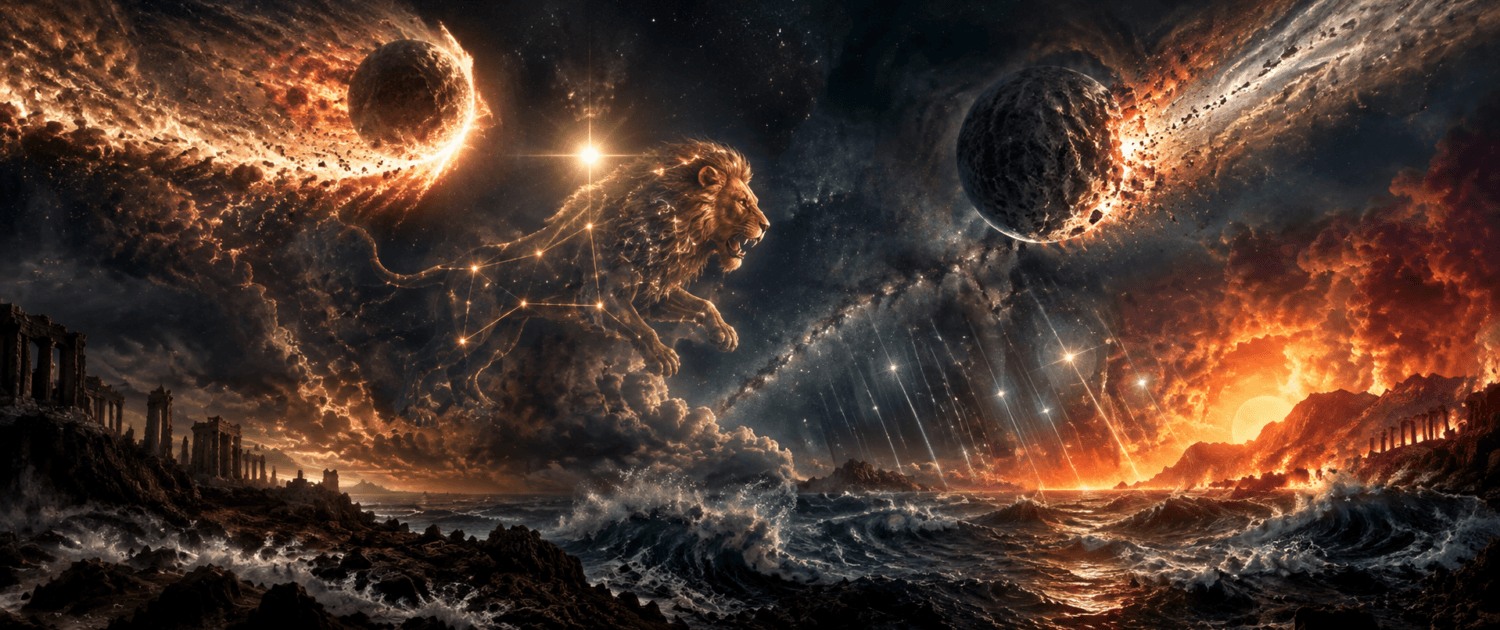
Two mighty meteors — of sun- and moon-like apparent size and shape — appear threateningly with their accompaniments. The star-world falls into turmoil, and the actual war begins: the Morning Star (Venus) opens it, standing on the back of Leo. Seven months later a new heaven results, as the Sun moves from about mid-Virgo to mid-Aries. The stars that ruled the dawning morning sky plunge at last into Okeanos and set the earth afire. Such is the fundamental thought — recognized only once facts beneath poetry’s veil are laid bare.
Explanation of the Text
1. The Prelude to the Star-War (Vs 512–515)
Vs 512 ἡλίου φαέθοντος ἐν ἀστράσιν εἷδον ἀπειλήν
“Of a shining ‘sun’ I saw the threat among the stars.”
Vs 513 ἤδὲ Σεληναίης δεινὸν χόλον ἐν στεροπῆςιν
“And of a moon the terrible wrath in lightnings.”
Vs 514 ἄστρα [μάχην] ώδινε· θεὸς δ’ ἐπέτρεψε μάχεσθαι
“The stars were labouring with battle. God suffered them to fight.”
Vs 515 ἀντὶ γὨρ ἡλίου μακραὶ φλόγες ἐστασίαζον
“For in place of the sun long flames contended / shot across.”
ἡλιος here is certainly not the daylight star — for it appears among the stars. It is a meteor as large as the sun, threatening as it blazes up. Babylonians called such *šamšu*, “sun.” Its shape varies, often like a partially-lit lunar disc — and of such a one Vs 513 speaks: its “terrible wrath” shows itself in lightnings. The real Moon neither flashes nor thunders; the meteor-“moon” does both, bursting like a heavenly bomb [6]. Thus stars are thrown into turmoil (Vs 514). In place of the meteor-sun, “long flames” shoot across — fragments breaking up in the atmosphere, leaving glowing crossing tails.
2. The Actual Star-War (Vs 516–531)
Vs 516 Φωσφόρος ἔσχε μάχην ἐπιβὨς ἐς νῷτα Λέοντος
“The Morning Star directed the battle, mounting upon the back of Leo.”
The equation Φωσφόρος = Venus as morning star was previously assumed. The word can also denote Hesperus (evening star) [9]. Here it needs proof: Venus stood on the back — eastern part — of Leo. If she were evening star, the Sun would be in western Leo or Gemini; but Vs 206–213 shows the Sun was in Virgo — so Venus is morning star. The opposite assumption yields only confusion.
Why does Morning Star lead and bestride Leo? Its home is Babylon. There Venus-morning-star = Ištar-kakkabē, “male” (*zikarat*), by contrast with evening-star Bêlit-ili, goddess of love [12]. The morning star is the battle-ready leader of the host — Venus being a war-goddess since Babylon’s First Dynasty. Its animal is the lion (cf. Malta(ja) relief; Babylonian *kakkar niṣirti*). Istar’s cult spread to Greece, Rome, Carthage as Cybele / Mother of Gods / Caelestis — all with lion companion.
Vs 517 ἤδὲ σεληναίης δίκερως ἰλλάξατ’ ὀιζύς
“Of the moon did the two-horned sorrowful shape change itself.”
The “sorrow” (ὀιζύς) is the waning crescent’s progressive darkening before conjunction — an ancient Babylonian notion. On the last visible crescent day they feasted Nergal, mourning him next day; three days later the young crescent reappears westward as Sin’s new-moon feast. That change the poet means: the moon passed from eastern morning (old light) to western evening sky (new light). Beginning of war lay when Sun was ~15° Virgo; its end when it reached 15° Aries — 209.4 days = 7 synodic months + 2.7 days apart (~100 B.C.). So for luni-solar calendars a new month, and for Babylonians/Hebrews of Seleucid-Parthian times the spring New Year began.
“Seven” — in Babylonian and Jewish thought — expresses completion. And the moon finally enters Taurus, its *hypsōma*, place of greatest power. Vs 517’s Moon is Earth’s regular companion, unconnected with Vs 513’s meteor.
Vs 518 Αἰγόκερως δ’ ἔπληξε νέου Ταύροιο τένοντα
“The Goat (Capricorn) struck back the neck of the young Bull.”
Vs 519 Ταῦρος δ’ Αἰγοκέρωτος ἀφήρπασε νόστιμον ἦμαρ
“But the Bull robbed the Goat of his day of home-coming.”
At war’s beginning (sun mid-Virgo) Taurus rises neck-first at nightfall — hence “young.” Its head bent eastward suggests a hostile thrust from the west; culprit is Capricorn, fled westward past meridian. Through following months (Sun in Libra, Scorpio, Sagittarius) Taurus climbs higher pursuing the retreating Goat until it vanishes into sunset glow — robbed of its day of return. Already this shows Vs 517’s phase-change spans several months.
Vs 520 καὶ Ζυγὸν ὦρίων ἀπενὁσφισε μηκέτι μεῖναι
“Orion removed the Balance (Libra), so that it no longer remained.”
Not heliacal setting — the poet wouldn’t mention Capricorn then an earlier Libra. Rather: when Sun was mid-Virgo, Libra’s stars set within ~one hour of nightfall; seven months later (Sun mid-Aries) most Orion stars did likewise, at nearly the same horizon point.
| I. Sun in 15° Virgo | Sidereal time |
|---|---|
| End of astronomical evening twilight | 18h42m |
| Setting α Librae | 18h54m |
| Setting β Librae | 19h28m |
| Setting β Scorpii | 19h41m |
| II. Sun in 15° Aries | Sidereal time |
|---|---|
| End of astronomical evening twilight | 8h32m |
| Setting π³ Orionis | 9h00m |
| Setting β Orionis | 9h04m |
| Setting η Orionis | 9h29m |
| Setting γ, ε, κ | 9h39m |
| Setting ζ Orionis | 9h42m |
The belt-stars δεζ Orion have declinations −4°02′, −5°00′, −5°03′; α Librae −5°05′ — nearly identical setting points. So on the last day of battle Orion stood at nightfall where Libra had been seven months before: “Orion removed the Balance.” Beyond doubt.
Vs 521 Παρθένος ἐν Κριῷ Διδύμων ἰλλάξατο μοῖραν
“The Virgin in Aries exchanged her portion with the Twins.”
The role Virgo played at war’s start — Sun within, Venus shining above it at dawn — falls after seven months to Aries; they have “Dioscuric” character (when one rises, other sets).
Vs 522a ΠλειὨς δ’ οὐκέτ’ ἐφαινε
“The Pleiad shone no more.”
Meaning: the Pleiades had heliacally set. At latitude 30–33°, that occurred ~7 April (300/200 B.C.) or 8 April (~100 B.C.), at solar longitude 13–15°. The war ended soon after — last day of battle about 8 April, the day after η Tauri’s setting.
Vs 522b Δράκων δ’ ἤρνήσατο ζώνην
“The Dragon denied (avoided) the belt.”
The northern Draco, between Hercules/Ursa major and Ursa minor. “Avoiding the belt” = at war’s end it stood all night above the horizon, unlike at start. Computation confirms: about 100 B.C., at latitude ~30°, its head stars could set — but with Sun mid-Aries, βγ Draconis rose by 7h03m and stayed up ~6h50m after sunrise.
| Year −100 (=101 B.C.) | α | δ | b=+30° rise/set | b=+33° rise/set |
|---|---|---|---|---|
| β Draconis | 251.028 | +54.096 | 7h03m / 2h27m | 6h14m / 3h17m |
| γ Draconis | 257.032 | +52.090 | 7h50m / 2h28m | 7h13m / 3h06m |
| Sun in 15° Virgo | 166.022 | +5.097 | 4h51m / 17h19m | 4h48m / 17h20m |
| Sun in 15° Aries | 13.078 | +5.097 | 18h41m / 7h09m | 18h40m / 7h11m |
The contrast is sharpest at b=30°; at b=33° it nearly vanishes once refraction counts. Hence the “star-war” was composed in Lower Egypt — Cairo 30°, Alexandria ~31°; Athens (where no Draco star set) is excluded.
Vs 523 Ἰχθύες εἰσεδύοντο κατὨ ζωστῆρα Λέοντος
“The Fishes crept away opposite the belt (girdle) of Leo.”
A dawn scene: freshly-heliacally-risen Pisces eastward, Leo westward; near Sun mid-Aries its stars fade — they “creep away” before Leo. The *zōstēr* is the ecliptic belt-piece of Leo.
Vs 524 Καρκίνος οὐκ ἐνέμεινεν, ἔδεισε γὨρ ὦρίωνα
“The Crab (Cancer) did not hold his ground; for he feared Orion.”
Not fleeing nor heliacally setting — Cancer lies east of Orion and follows it. Rather: even stable Cancer is carried off by the overturning, obeying warrior Orion.
Vs 525 Σκορπίος οὐρὨν ἐπῆλθε διαδεινοῖο Λέοντος
“The Scorpion set upon the tail of the utterly terrible Lion.”
Only astronomy unlocks this. As Leo’s head/breast pass meridian and hind-body stars ρ,δ,θ,β culminate, Scorpio’s stars rise in succession (head-stars at 8h36–40m sidereal). With Sun mid-Aries it sets 7h09m, starnight begins 8h32m: Scorpio’s head-rising is the first clear star-appearance eastward while terrible Leo stands in mid-heaven; as Leo’s tail-star β crosses meridian, Scorpio’s last (λ) rises. Then following descending Leo, Scorpio’s head-and-breast set while its tail culminates; Leo fully sets 17h03m sidereal just before dawn (sunrise-sidereal 18h41m). So Leo’s complete setting is the night’s last event westward — all night long Scorpio pursues Lion and tail.
The text-criticism: combine διὨ + δεινοῖο into διαδεινός (“utterly terrible”) — formed like διάδηλος/διάπλεως, philologically sound.
Vs 526 ἤδὲ Κύων ώλισθεν ἀπὨ φλογὸς ἡλίοιο
“And the Dog slipped away from the flame of the Sun.”
Canis maior / Sirius no longer stands high at nightfall but near western horizon, to vanish wholly within a month in the set sun’s rays [17] — poetically an effect of solar scorch.
Vs 527 Ὑδροχόος δ’ ἐπύρωσε μένος κρατεροῖο Φαεινοῦ
“But the Water-bearer (Aquarius) inflamed the might of strong Phaeinos.”
Alexandre/Blass read “Lucifer/morning star”; Geffcken sets Φαεινός = Φαίνων, Saturn. If so, sense is: Aquarius conferred new brilliance on the planet — Saturn rose heliacally in Aquarius, growing clearer over the next month. Grounds: epithet κρατερός (“strong”) fits Saturn, mightiest of planets (Pseudo-Manetho IV 14–15); Aquarius is Saturn’s nocturnal *oikos*; and Ptolemaic chorography assigns middle Ethiopia to both Aquarius and Saturn — so Saturn appears as ally, not foe.
Vs 528–531 ὄρτο μέν Οὐρανός ἀυτός, ἕως ἐτίναξε μαχητὨς· / θυμωθεὶς δ’ ἔρριψε καταπρηνές ἐπὶ γαῖαν· / ῥίμφα μέν οὕν πληγέντες ἐπ’ ὦκεανοῖο λοετρά / Ἡψαν γαῗαν ἅπασαν· ἔμεινε δ’ ἀνάστερος ἀἰθήρ
“Uranus (Heaven) himself arose, until he shook the combatants; / angered, he hurled them headlong to earth. Swiftly then struck down into Okeanos’ baths / they set all the land afire; and aether remained without stars.”
At start (Sun mid-Virgo), Aries-Taurus-Gemini-Orion-Cancer-Leo stood in dawn sky; seven months later, sunk. Simultaneously Ethiopia’s hot season begins — folk-poetically tied to those constellations’ descent into Ocean that girds the earth: the “hot region” of the ecliptic. So no star is visible by day.
Γαῗα (“earth”) means here not the globe but the whole land — Ethiopia (= ὅλη γῆ Αἰθιοπήων, Vs 212).
The Parallel Passage Vs 206–213
(The scan is garbled in the opening lines of this section; its substance follows. —trans.) Geffcken admitted “a certain distant resemblance” between Vs 512ff. and “the quite corrupt piece” 202?/206–213, but attempted no real explanation.
Vs 207 Ἰνδοί, μὴ θαρσεῖτε [=ταρβεῖτε], καὶ Αἰθίοπες μεγάθυμοι
“Ye Indians, be not confident — nor you, great-hearted Ethiopians!”
Vs 208–210: “For when round these the wheel of Capricorn’s axle / and Taurus with the Twins swing about mid-heaven, / when Virgo rises and the Sun, having fixed a belt (girdle) around its brow, rules all-around the pole/world.”
Vs 211–213: “There will be a great heavenly conflagration upon earth, / and from the fighting stars a new nature, so that perishes / in fire and groanings the whole land of the Ethiopians.”
Text-critical notes (Kugler)
- Vs 206: read θαρσεῖτε (with Alexandre) for ταρβεῖτε.
- Vs 207: “τούτους” must remain (Geffcken’s πυρόεις unneeded).
- Vs 210: περιπὨμπολον is no inadmissible coinage (cf. περιπὩμπαν).
- Vs 212: mss. “ἄστρων δ’ ἐν μαχίμοις” — Geffcken’s “[ἐκ]” factually right.
- Vs 213: reading “Αἰθιοπήων” (from Alexandre) proves unnecessary to alter further.
The figure in the book: E = ecliptic, H = horizon at O. Virgo rises east with Sun ⊙ in its middle; Gemini & Taurus stand east/west of mid-heaven; LMP is Capricorn’s “axis.” τροχὸς = a flywheel by which Capricorn is set rotating — recalling the Pythagoreans, who (per Achilles Tatius, *Isagoge* 18) taught fixed stars move like an auger (τρύπανον) about one point. At the event’s time Capricorn’s axis points southwest — where, from Lower Egypt (poem’s home), Ethiopia lay.
Vs 208: Taurus and Gemini share a boundary on the meridian. Vs 209–210: Virgo rising with Sun = same season as war’s start (Venus bestriding Leo); the “belt” fixed about the sun’s brow is simply the dark horizon-strip around the risen disc (ζώνη = “horizon”). Vs 211–213: the star-war causes a great overturning and scorching heat over Ethiopia.
The “Indians”: Geffcken said the poet forgot them. Not so — per Herodotus VII 70, “the whole land of the Ethiopians” united two races: sunrise-Ethiopians (= part of India’s dark Kalatiae, in Xerxes’ army assigned to Indians) and Libyan (African, upper-Nile) Ethiopians. Thus calling eastern Ethiopians “Indians” was apt — no oversight.
Part II: The Naturalistic Fundamental Idea of the Phaëthon Legend
Geffcken finds a striking kinship between Sibyll. V 512ff. and versions of Phaëthon’s fall — he who set the world on fire and gave Indians/Ethiopians dark skin, especially in Nonnos’ *Dionysiaca* XXXVIII.
1. Who or what is Phaëthon?
A pure fantasy? Hardly. Earlier theories — sunset-symbolism (Robert) and morning-star (Wilamowitz, Knaack) — both fail: evening-red is too ordinary for so violent a saga, nor could Venus awaken world-catastrophe imagery. But consider these traits of Phaëthon:
- He is not merely Helios’ surname but equated with him (esp. Nonnos) — an hypostasis of the Sun or a sun-like body;
- he takes the charioteer’s place, while Helios rides along;
- his course deviates wholly from the Sun in direction and speed;
- the starry sky blazes;
- he is struck by lightning and falls;
- his fire ignites the earth.
“With these there agree perfectly certain meteor phenomena.” Ancient and modern observers saw meteors of solar size/brilliance crossing at speed, exploding amid lightning/thunder, their glowing fragments setting fields alight. Johannes Antiochenus (after Plutarch) already traced the legend to a fireball’s fall; Valerius Flaccus thought of a meteor (*globus ater*). So in both Phaëthon-legend and Sibylline finale the star-war is introduced by a shining meteor-sun, on the morning sky — completing Phaëthon’s Helios-character. Venus rises as morning star alike in *Dionysiaca* XXXVIII 365 and Sibyll V 516.
2. The Star-War of the Dionysiaca and that of the Sibyllines
(Full rendering of Nonnos, Dionys. 349–409 preserved in translation file.) The difference is deep-going: Nonnos paints deliberate fantastic confusion — stars colliding in frenzy; the Sibyllist encodes real astral changes over seven months. Shared star-names prove nothing; only relations among same-named stars matter, and there the two poems stand maximally opposed (cf. Draco/Taurus, Sirius/Leo).
3. Phaëthon’s Fall into Eridanus: World-Fire and Deucalionic Flood
Zeus’ lightning hurls the disturber into earthly Eridanus; he becomes Auriga. The Sibyllist knew this legend — his ἡλιος φαέθων is a sun-like meteor; and since Zeus/Jupiter must fall as pagan, the lightning-scene passes to a moon-like exploding meteor (V 513). Hence two meteors in the prelude. Phaëthon’s lot transfers onto the stars — they become immediate cause of earth-fire, over “the whole land of the Ethiopians.” Ovid mentions it only in passing (*Metam.* II 235: *Sanguine tunc credunt … Aethiopum populos nigrum traxisse colorem*).
Simultaneity of fire and flood: older interpreters of Plato’s Timaeus 22 set Phaëthon-fire in Ethiopia, Deucalion-flood in Thessaly — reckoning with real events. Testimonies: Celsus (apud Origenes) as historical facts; Tatian (*Orat. ad Graec.* 60); Clement of Alexandria citing Thrasyllus’ chronology (fire-and-flood to Troy = ~330/340 years); Eusebius (“flood in Thessaly under Deucalion, conflagrations in Ethiopia under Phaëthon”); Augustine/Varro (flood “by no means reached Egypt and its neighbourhood”); Orosius; Cyril.
Even without secure chronology, we may not deny these traditions all historical core.
If fire and flood occurred simultaneously, one common cause is demanded. Since Phaëthon’s fire rests on a meteor — so must the great flood. Two facts: (1) large meteors occur in swarms/streams of enormous breadth, so widely separated regions can be affected at once; (2) bigger masses lose less cosmic speed (up to 60 km/s), driving deep into earth — witness Coon Butte crater, Arizona (1150 m diameter, 125 m deep, wall 40–50 m high, sandstone belt 6½ km wide). “One and the same meteor stream could have passed over Africa/Ethiopia — great fires there — and over the Aegean, raising tidal waves here.” A similar fall into a Thessalian bay would unleash steam-expansion flash-floods. Thus the Deucalionic flood and its simultaneity with Phaëthon’s fire find explanation.
And so Eridanus = the Aegean. Sibyll V 316: Λέσβος ἐπ’ Ἠριδανὸν ἀἰώνιον ἐξαπολεῖται — “Lesbos shall go to destruction forever by Eridanus.” Strabo called Eridanus a river nowhere to be found; Herodotus/Pliny/Apollonius place it variously (Po, Rhone-sea). “Eridanus is wherever local legend puts Phaëthon’s fall” — the diversity itself testifying to simultaneous meteor effects in many places.
The name’s home: Babylonian sky has a constellation named for holy city Eridu, at “the mouth of the rivers” (Euphrates+Tigris) — Vela + south Puppis. Eridanus per Eratosthenes reached to Canopus. Thus Eridanus is heaven’s image of Euphrates-and-Tigris united: beyond Cetus lay Tigris-star (east) and Euphrates-star (west). Greek origin asserted by Herodotus, but good grounds argue Babylonian.
The Universal Fire & Flood of Stoic Cosmology
Besides local catastrophes, antiquity knows a universal, periodically-recurring destruction by fire (*ekpyrōsis*) then water (*cataclysmos*) — not from history but cosmological speculation (Stoicism per Demokritos). Seneca’s *Consolatio ad Marciam*: “stars will rush upon stars… burn in one fire”; his flood picture too. Both have “one and the same ground.” He liked Berosos’ explanation: earth-fire when all planets conjoin in Cancer; flood when they meet in Capricorn (the solstitial points). Censorinus (*De die natali* 18,11) on the Great Year agrees.
The universal catastrophes differ from Phaëthon/Deucalion not only by universality and cause but by non-simultaneity — separated by vast periods, repeating periodically. There stars self-destruct in Fate-driven collapse; that is no “star-war.” Yet the two kinds were conflated: Celsus reproached Christians (apud Origenes c. Celsum IV 11) for mishearing cyclical cosmology into an imminent divine fire-judgment — a groundless charge, but natural since younger Stoics themselves classed Phaëthon/Deucalion among the periodic catastrophes.
Manilius (*Astron.* IV 829ff.) makes world-catastrophes of them yet lets Deucalion live and earth escape in terror — contradicting his own system. Seneca is wiser, mentioning neither when treating planetary-conjunction fires/floods.
[Back matter]
kugler1927_translation_EN.md. — This HTML rendering omits a few scan-garbled Greek words (restored from context) and the OCR-duplicated blocks of the two-column source.
The discovery forced a rewrite of what archaeologists thought they knew about underground construction in the ancient world. Before 1963, the largest known subterranean complexes were the Roman catacombs and the Basilica Cistern in Istanbul. Derinkuyu alone could hold twenty thousand people. Kaymaklı, nine kilometres away, was larger still. The two were probably connected by a tunnel whose ventilation shafts have since been filled with rubble.

The drift is a remarkable stratum of clay, sand, gravel, and far-from-source boulders seemingly flung by some careless hand over the northern portions of Europe and North America. Some of this debris has been moulded into distinctive ridges (moraines), rounded hills (drumlins), and long sinuous ridges (eskers). Any theory of drift formation must account for these singular accumulations as well as an immense family of scratches, lake basins, and sundry gougings.

“Just as in the case of all other countries, the earliest pages in the Geological Record of South Africa are most fragmentary and utterly confusing; much remains to be done before even the outlines can be reconstructed. It must suffice to remark that at some extremely remote date, possibly more than 1000 million years ago, basic lavas—seemingly the earliest known of the rocks—were being poured out over several large sections of this country, in many places sub-aqueously—probably upon the ocean floor—that they were accompanied and followed by tuffs, slates, limestones, and the remarkable group of the banded ironstones, jaspilites, and cherts, and by quartzites, grits, and conglomerates.”
The first obstruction to knowledge is often not the world itself, but the human instrument by which the world is received.
A people who saw the sea arrive where no sea belonged would not leave behind a peer-reviewed monograph. They would leave a story. And the descendants of that story would eventually be mocked by men who mistake their own notation for reality.