

Modern academia has become incredibly tolerant of abstract concepts that don’t challenge its self-image. It can accept invisible dimensions, inaccessible universes, speculative cosmologies, and ontologies beyond human experience. These are allowed because they are neutral. They don’t criticise history, they don’t affect memory, and they don’t question whether the human past contains evidence that modern institutions have deliberately ignored. But if you suggest that ancient societies may have preserved cultural remnants of real planetary disorder – oceanic displacement, celestial irregularity, atmospheric darkness, geomagnetic disturbance, seismic convulsion, or abrupt climatic rupture – and the room changes.
The objection is rarely neutral. It arrives too quickly, carrying too much heat. It speaks in the tone of defense before the evidence has even been examined. Why? Why study culture if human memory can’t preserve trauma? If myths lack historical evidence, why do alll civilisations record floods, fires, darkness, sky disorders, migrations, destructions, and renewals? If symbolic transmission is automatically rejected by distortion, what is the point of archaeology, which reconstructs vanished worlds from fragments?
Modern scholars are at ease with broken pottery, but uncomfortable with broken memory. They infer trade routes from beads, ritual from bones, hierarchy from tombs, and diet from residue. However, when tradition is treated as residue, caution becomes prohibition. This is reflex as substitute for rigor.
The main mistake is that modern thinking mixes literalism with seriousness. Ancient memory is symbolic, so it’s seen as unserious. But symbolism isn’t childishness. It’s compression when there’s loss. It’s what survives when measurement fails and/or the means to make them is lost or non-existent, and trauma must be passed down through generations by minds instead of archives. A people who saw the sea arrive where no sea belonged would not leave behind a peer-reviewed monograph. They would leave a story. And the descendants of that story would eventually be mocked by men who mistake their own notation for reality.
This is the conceit at the heart of the matter. Modern institutions believe they alone possess disciplined memory because they possess technical language. Yet equations, models, classifications, and chronologies are also symbolic systems. They too compress reality, omit context, decay and depend upon priesthoods of interpretation.
The difference is not that one world was symbolic and the other scientific …it is that one remembers its symbols are symbols.
“It is difficult to get a man to understand something when his salary depends upon his not understanding it.”
— Upton Sinclair
The academy has become self-destructive precisely because it has confused method with metaphysics. It no longer merely employs disciplinary boundaries; it genuinely believes in them. A paleomagnetist might discuss excursions, a climatologist abrupt transitions, a sedimentologist, anomalous deposition, an archaeologist collapse, a historian migration and a mythographer flood traditions. Each fragment is admissible in isolation. The “crime” is synthesis.
Synthesis is not weak, but it challlenges ownership, demonstrating that categories were created for administrative purposes, not natural ones. The Earth didn’t divide into departments, and instability didn’t require a faculty meeting. The sea, sky, field, crust, climate, and human nervous system belonged to one event-space long before universities started dividing ignorance. This is why convergence provokes hostility.
A sediment layer can be contained.
A geomagnetic anomaly can be contained.
A displaced shoreline can be contained.
A ruined settlement can be contained.
A myth can be contained.
But dare place them near one another and containment begins to fail. The institutional mind then resorts to ridicule, not as an argument, but as a cheaper alternative to reconsideration. It acts as an exclusionary force, disguising itself as intelligence, and dictates what should not be considered. Ridicule is not a scientific method. It is a social quarantine.
The academy rightly warns against pattern-seeking, as false synthesis is real. Humans often connect unrelated dots, leading to catastrophic imagination that can become theatrical, undisciplined, or even pathological. However, the opposite failure, trained pattern-blindness, is now more respectable and therefore more dangerous.
A scholar can become so disciplined that they lose the ability to notice patterns across different areas. They can become so committed to their methods that they forget their purpose. They can mistake refusal for scepticism, narrowness for precision, and professional discomfort for maintaining epistemic standards.
The result is a peculiar intellectual cowardice dressed in cautious language. We are told not to overinterpret. Very well. But who benefits from systematic underinterpretation? Who benefits when ancient memory is treated as noise by default? Who benefits when every catastrophic trace is isolated inside its own technical silo? Who benefits when the past is permitted to be violent only in ways that do not disturb the present?
Continuity is the mythology of managerial civilization. It reassures us that institutions sit atop stable foundations, that progress unfolds against a benign planetary background, that disruption is local, that collapse is human-made, that the Earth is scenery rather than actor.
Catastrophe violates this metaphysics. It says civilization may be episodic, and that the ancient world may not have been merely superstitious, but injured. It says modernity may be less an awakening than a very sophisticated amnesia. That is why the subject irritates. Not because it is absurd, but because it is intimate.
“The human race, collectively, is in a state of amnesia.”
— Immanuel Velikovsky
What exactly is myth? It’s often used as a catch-all category. Modern scholars can file away inconvenient continuity without openly denying it. Myth becomes the dumping ground of disciplined memory: too structured to ignore, too symbolic to admit, too persistent to be accidental, too dangerous to be read plainly. So it is aestheticized. Psychologized. Ritualized. Moralized. Anything but investigated as a possible residue of actual encounter.
Human beings don’t invent the same terrors everywhere for no reason. They don’t repeatedly remember world-fire, deluge, darkness, falling sky, displaced waters, cosmic combat, and ages ending simply because they lacked imagination. The lazy explanation is that modern scholars may dismiss those images without consequence, not that ancient people encoded memory in grand images. There is a sedimentary record in culture.
Cultural strata, like geological strata, are disturbed, folded, intruded upon, eroded, and overwritten. Their original deposition is rarely recoverable in pristine form. However, deformation does not mean annihilation. A folded bed remains a bed, a displaced layer remains evidence, and a myth altered by centuries retains its origin. The task is not to believe every ancient catastrophe story, but to stop pretending that disbelief is a substitute for analysis.
A mature science of human history would not compare myths to geology, memory to measurement, or symbols to events. Instead, it would ask more profound questions: where do motifs cluster, align with environmental changes, or preserve compatible structures across independent traditions? Where do dates, shorelines, ruins, magnetic anomalies, climatic pulses, and linguistic remnants begin to form weak but non-random associations.
That is inquiry.
The academy’s failure lies not in rejecting catastrophic syntheses, many of which deserve it. It fails to reject the category before evidence arrives, policing the doorway and mistaking forbidden synthesis for error.
This habit will age badly.
“Men occasionally stumble over the truth, but most of them pick themselves up and hurry off as if nothing had happened.” — Winston Churchill
Future scholarship may be less impressed by our caution than by our omissions. It may wonder why a civilisation with advanced technologies remained so cautious before the possibility that human and Earth memories sometimes describe the same wound.
The answer will not flatter us. We were not too rigorous. We were too comfortable. The ancient world may have lacked our instruments, but it did not lack experience. It knew the sky was not guaranteed. It knew seas moved. It knew darkness could descend. It knew ages ended. It knew memory was a form of survival.
Modernity, born inside a narrow interval of climatic and geophysical mercy, mistook that mercy for law. The defining superstition of this age may well turn out not to be myth, but stability.
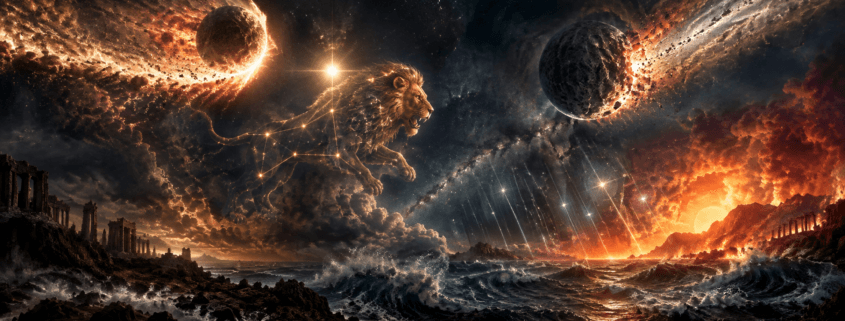
“Two mighty meteors — of sun- and moon-like apparent size and shape — appear threateningly with their accompaniments. The star-world falls into turmoil, and the actual war begins: the Morning Star (Venus) opens it, standing on the back of Leo. Seven months later a new heaven results, as the Sun moves from about mid-Virgo to mid-Aries. The stars that ruled the dawning morning sky plunge at last into Okeanos and set the earth afire. Such is the fundamental thought — recognized only once facts beneath poetry’s veil are laid bare.”
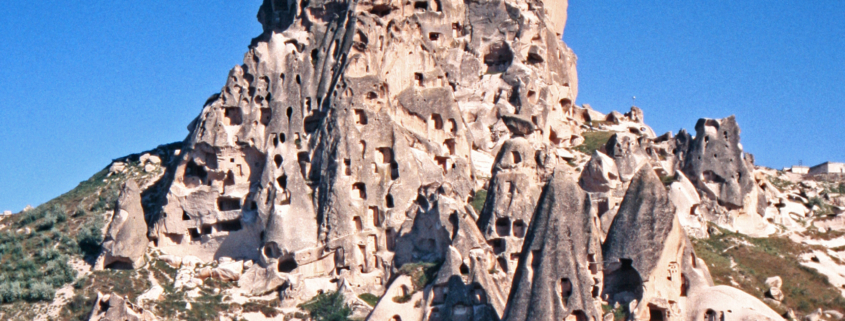
The discovery forced a rewrite of what archaeologists thought they knew about underground construction in the ancient world. Before 1963, the largest known subterranean complexes were the Roman catacombs and the Basilica Cistern in Istanbul. Derinkuyu alone could hold twenty thousand people. Kaymaklı, nine kilometres away, was larger still. The two were probably connected by a tunnel whose ventilation shafts have since been filled with rubble.
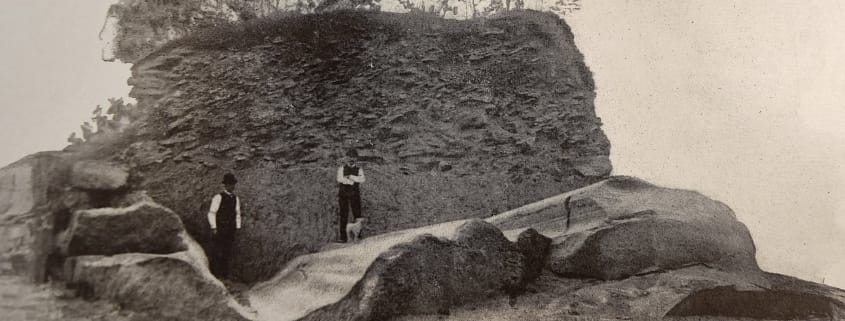
The drift is a remarkable stratum of clay, sand, gravel, and far-from-source boulders seemingly flung by some careless hand over the northern portions of Europe and North America. Some of this debris has been moulded into distinctive ridges (moraines), rounded hills (drumlins), and long sinuous ridges (eskers). Any theory of drift formation must account for these singular accumulations as well as an immense family of scratches, lake basins, and sundry gougings.

“Just as in the case of all other countries, the earliest pages in the Geological Record of South Africa are most fragmentary and utterly confusing; much remains to be done before even the outlines can be reconstructed. It must suffice to remark that at some extremely remote date, possibly more than 1000 million years ago, basic lavas—seemingly the earliest known of the rocks—were being poured out over several large sections of this country, in many places sub-aqueously—probably upon the ocean floor—that they were accompanied and followed by tuffs, slates, limestones, and the remarkable group of the banded ironstones, jaspilites, and cherts, and by quartzites, grits, and conglomerates.”
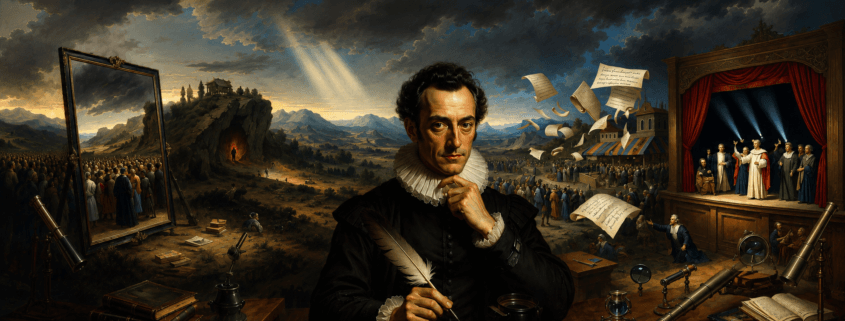
The first obstruction to knowledge is often not the world itself, but the human instrument by which the world is received.