

The Dawn of History
Just as in the case of all other countries, the earliest pages in the Geological Record of South Africa are most fragmentary and utterly confusing; much remains to be done before even the outlines can be reconstructed. It must suffice to remark that at some extremely remote date, possibly more than 1000 million years ago, basic lavas—seemingly the earliest known of the rocks—were being poured out over several large sections of this country, in many places sub-aqueously—probably upon the ocean floor—that they were accompanied and followed by tuffs, slates, limestones, and the remarkable group of the banded ironstones, jaspilites, and cherts, and by quartzites, grits, and conglomerates.
This primitive crust to the earth was next rent by vast protrusions of granite and gneiss, which crumpled up and highly metamorphosed the shattered remnants, producing banded “ortho-” and “para-gneisses,” granulites and schists of various kinds on a huge scale, which were then pierced by younger stocks of granite derived very probably from the same magma.
Of the disposition of the lands, whence these masses of sediments were derived, almost nothing is known; some of the formations appear to have been laid down in the ocean, others are more probably of continental origin, while glacial conditions can be deduced for one Series.
Their correlation with the primitive formations of other countries, based as it must be on lithological characters very largely, is attended by serious difficulties owing to the fact that certain kinds of sediment met with are of types that have repeatedly been laid down in times prior to the Palæozoic and cannot be said to characterise one particular period; such is the case with the banded ironstones for example. Attention should, however, be drawn to the remarkable lithological parallelism with the rocks of the Dharwar System of India, particularly their development in Mysore State, those of Western Australia and of Eastern Brazil. The first two countries display an abundance of granulites, greenstones, epidiorites and banded ironstones, noteworthy being the fact that in Australia certain of the latter have, like a few of those in Rhodesia, arisen by the metasomatic alteration of sheared igneous rocks. It is not unlikely that these four countries were already connected, seeing that they were apparently united at the beginning of the Devonian. They are also in agreement in that the intrusion of the batholithic granites led in each case to an extensive mineralisation of the invaded formations and to the production more particularly of auriferous lodes.
That the ancient complex of South Africa was the product of more than one geological revolution is clearly indicated by the existence of the Eldorado-Ndutjana-Shamva-Mbeza Series with conglomerate beds crammed with pebbles of banded ironstone, the result of erosion of these earlier strata and of their granitic intrusions, and of the unconformities between the several earlier groups in South-West Africa and Zululand. Patient detailed work will, in the future, piece together from the disjointed fragments of the record a story, going further back as well as forward, of repeated sedimentation, volcanism, plutonic injection and diastrophism covering most of the period embraced within the era known as the Ep-archæan.
The Witwatersrand System
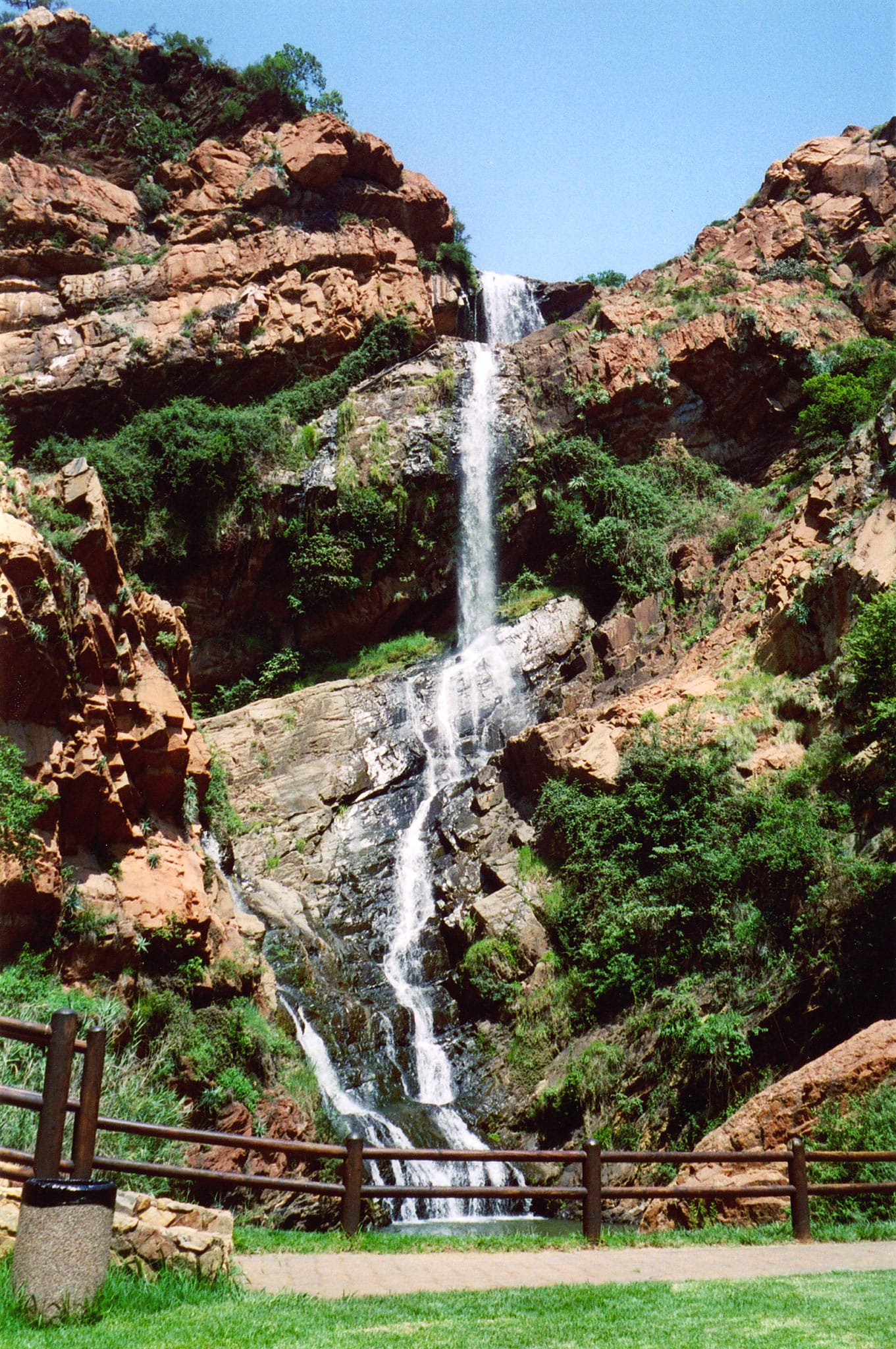
Witpoortjie Falls in the Walter Sisulu National Botanical Garden, formerly the Witwatersrand National Botanical Gardens. Waterfalls like this, cascading over a 56-kilometre-long (35 mi) quartzite ridge in Gauteng gave rise to the name “Witwatersrand”, which means “white water ridge” in Afrikaans. Source.
We are on safer ground on coming to treat of this formation, so notable a contributor to South Africa’s prosperity. The worn-down southern part of the Transvaal was invaded apparently from the south by a shallow sea in which were deposited sands and muds—the latter frequently ferruginous; noteworthy is the absence of limestone. The pebbles of bluish and dark quartz, quartzite, quartz-porphyry, jasper, and banded chert are all such as would be furnished by a region built of the Primitive Formations with their many veins of dark quartz of a frequently auriferous nature. During, though principally about the middle of the period the shallowing of the water led to the emergence of the sea-floor, to the production of extensive beaches, and to the development ultimately of great delta-flats, upon which river-systems descending from the north-west, discharged sands and pebbles. Associated with the gravels were auriferous “black sands” containing haematite, magnetite, ilmenite, chromite, zircon, and iridosmine—like those worked for gold in certain parts of the world. From time to time thin layers of pebbles, along with heavy mineral concentrates, were spread out in regular sheets, occasionally channelled by shallow stream-courses with a general south-easterly trend; the shoots of pebbles of larger size possess a similar direction, while there is a general falling-off in diameter and in number towards the south-east, all of which indicates rivers flowing towards that quarter. Subsequently the iron minerals were converted into pyrite, the particles of alluvial gold recrystallised and the sands changed into quartzites and the gravel-beds into “bankets,” an action that must have been accomplished quite soon, since pebbles of the banket are to be found in the succeeding Ventersdorp conglomerates. In the meantime elevation was in progress in the north and north-west, with the result that the Lower Division was exposed, tilted up and denuded on the northern side of the Rand area and also to the north-west of Klerksdorp, and an abundance of coarse material discharged in a south-easterly direction to build up the pebble-beds of the Elsburg Series; towards Parys the sediments were of a finer nature. Whether or no the quartzite-grit group closely associated with the Ventersdorp lavas in the south-west of the Transvaal and along the Lower Vaal River is the equivalent of the Elsburg Beds, such deltaic conditions must have spread far to the south and south-west, the material being deposited in that quarter directly and unconformably upon the Witwatersrand and older formations. Whether the Witwatersrand System has its representatives elsewhere in or outside of this country is not settled, though the Pongola is very probably its equivalent; but attention might be drawn to the presence of diamonds of detrital origin in the banket, which thus recall the similar occurrences of that gem in conglomerates in the Vindhyan System of Peninsular India and in the Lavras Quartzites of Bahia, Eastern Brazil.

The Ventersdorp Contact Reef separates the Witwatersrand sediments from the thick pile of Ventresdorp Lavas. Notice also, at the right hand side of the photo, how the conglomerate becomes thicker as it steps from a hard quartzite onto a soft shale surface. In other words, it is the same principle as in Peneplanation, but at a much smaller scale. Source.
The Ventersdorp Eruptions
The dictum that prolonged sedimentation is terminated by volcanicity finds a good example in the vast effusions of the Ventersdorp System, which were typical “plateau eruptions.” Over the Rand-Parys area they followed conformably upon, and so terminated, the deposition of the Upper Witwatersrand Beds, but elsewhere the lavas were poured out over a surface generally of Witwatersrand or more ancient rocks, probably land for the most part. Local basins of sedimentation are indicated by boulder-beds, grits, sandstones, etc., that preceded or accompanied the effusions, as in the centre of the Mafeking district, at Omdraai’s Vlei near Britstown, along the Orange River Valley above Upington, and in the areas occupied by the Konkip Series in South-West Africa. In addition to the eruption of andesitic and basaltic lavas, acid types were poured out and breccias and tuffs formed, also intercalations of various kinds of sediments. As is usual with formations composed principally of eruptive materials, variations in character and thickness from point to point and local unconformities are not uncommon.
During and also following these eruptions came a further tilting up of the Witwatersrand succession, to high angles, accompanied by thrusting on a considerable scale, the fracture lines striking east-west on the Central Rand, but curving towards the south-west in the section between Roodepoort and Randfontein, of which we have a good example in the “Witpoortje break,” and continuing well beyond Klerksdorp. Indeed, allowing for some minor tilting and faulting experienced in post-Transvaal times, the structure on the Rand was largely fixed by the end of this period; many of the numerous basic dykes were furthermore introduced at about this time.
The internal stresses having been relieved in these ways, the crustal movements died down and South Africa entered upon one of those periods of relative stability, as to the time-value of which, like the pre-Witwatersrand or the post-Waterberg-Matsap breaks, we have no real idea; the corresponding pages in the geological record are unfortunately missing.
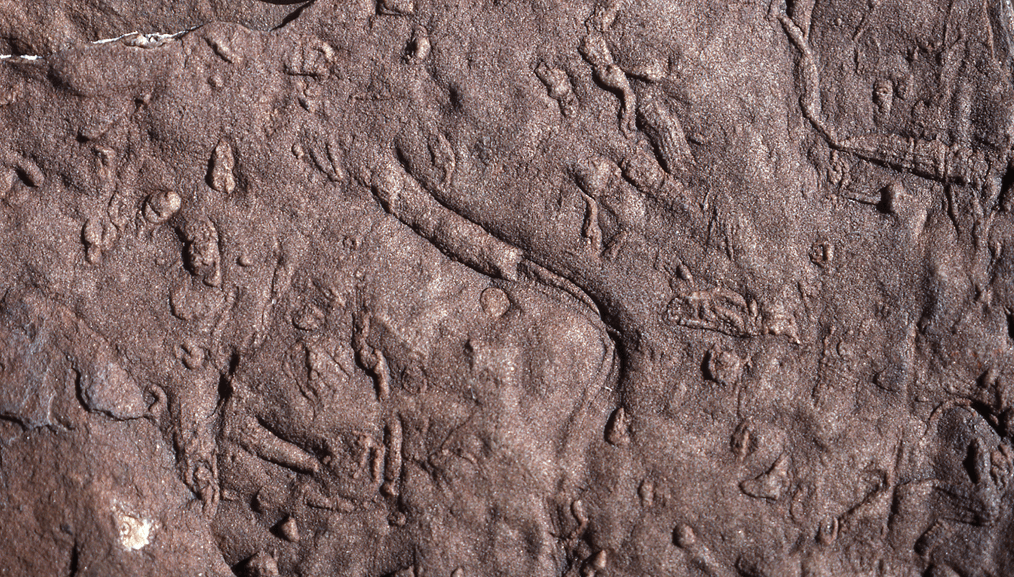
The holotype fossil of Archaeichnium haughtoni, including other specimens, Nama Group, Namibia. Source 1. Source 2.
The Nama-Transvaal Marine Submergence
During the intervening period, inferentially an extremely lengthy one, the country underwent a vast amount of erosion, whereby the greater part of the land area became worn down to a flat surface. Over a remarkably wide region it formed an absolute plain, but between Upington and Kalkfontein South, and also to both north and south of Kuibis, little tors or ridges were left, the summits of which remained exposed until long after the ground at their bases had been buried beneath sediment.
That the whole of this huge area then subsided beneath the waters of the ocean cannot be doubted, it being furthermore not unlikely that the great and extensive limestone formations in Katanga and along the Lower Congo were contemporaneously formed. If so, then toward the close of the late pre-Cambrian this subsidence brought about practically complete reversal of the respective areas occupied by land and sea. Only in two subsequent epochs did the ocean trench upon the continent, namely during the Devonian over the southern half of the Cape Province, and in the Cretaceo-Tertiary, though merely along the continental margins.
The arenaceous basal beds of the System represent inshore, shallow-water deposits laid down as the waves advanced over the peneplain, the thicker and generally coarser nature of which in the north-east of Lydenburg to the east and in the Maltahöhe district to the west, indicate the presence of land areas in those two directions, while the puny development and more argillaceous habit along the Lower Vaal River suggest shallower water. With subsidence of the floor and retreat of the land-margins, shales, and limestones accumulated, a purely carbonate phase prevailing over the Transvaal, northern Free State, Griqualand West, and Ovampo land (which we can suppose to have been covered by deep sea, one perhaps with warm waters), while a mixed argillaceous and calcareous phase prevailed in the Lomagundi district of Rhodesia and over the region extending from Windhoek southwards to the Cape and eastwards to Port Elizabeth at least. It might be pointed out that, where the limestones are fullest in their development, their dolomitisation has been most thorough, and furthermore, that the presence of manganese in them recalls the accumulation of this substance in the modern deep-sea oozes.

Nama Group, Namibia. (b, f) Kanies Member and transgressive surface that marks the base of the overlying Mara Member (dashed line). (c) Contact of base of Kanies Member with Proterozoic basement granite. (d) Asymmetric ripples on bedding surface in the lower Mara Mb. (e) Interference ripples in the lower Mara Mb. (f) Lower Mara Member showing cyclicity, and position of first appearance of dolostone relative to the basal Mara transgressive surface (dashed line). Source.
Shallowing of the Ocean
Sedimentation having finally overtaken subsidence, a series of dark shales and white quartzites were laid down in the Transvaal, in shallow water as disclosed by the false-bedding, ripple marks, and sun-cracks in the quartzites. Indeed, the local emergence of the top of the newly formed Dolomite in this Province has to be presumed because of the chert-conglomerate and the peculiar quartzite upon which the Pretoria Beds rest. The detritus was furnished by a land-mass situated apparently to the north and east, one subject to a high rainfall and possessing probably a cool climate—the glacial horizon in the Daspoort Group should be remembered in this connection.
In the southern and south-eastern part of South-West Africa on the other hand the succeeding red sandstones and shales and grey quartzites of the Fish River and Zwart Modder Beds suggest proximity to a land with a warmer climate, possibly one with a medium or low rainfall, under which oxidation of the rock-waste was general. Among the sediments deposited were ferruginous (magnetite) sands, while the cross-bedding in the red and striped sandstones points to strong currents and probably to wind-action, ripple-marking being common; possibly the area consisted of a wide tract of saline “shotts.”
Between these two regions of contrasting facies lay that of Griqualand West and Bechuanaland, wherein curious finely divided, highly ferruginous muds were dropped, evidently in quiet and fairly deep water, as signified by the marvellously close and even banding and the general absence of any but fine-grained material, except at a few localities on the south and west; there is, moreover, no break here with the Dolomite and chert group below. Their nearest modern representatives are apparently the red and blue terrigenous muds of the moderately deep parts of the ocean, but it seems not unlikely that chemical precipitation played an important part during their formation, as the high iron-content would suggest; indeed the introduction of the sodium necessary to the formation of the mineral crocidolite is hard to explain except as a secondary chemical process. That similar conditions must temporarily have extended themselves into the Transvaal is borne out by the considerable development of banded ironstones at the top of the Dolomite and occasionally on higher horizons as well.
Glacial Interludes
The existence at the beginning of ice-caps in the north-west and north is revealed by the important Numees glacials of Namaqualand, Namib, and Angola and the possibly contemporaneous ones of the Congo, while a minor recurrence, probably with floating ice, marks the Pretoria and Griquatown Series. The inclusions in the younger tillite have not been traced, though the false-bedding in the grits and conglomerates on this horizon at Ohrigstad in Lydenburg indicates a northerly derivation; pebbles of chert from the Dolomite are common here. Comparable is the tillite in South Australia near the base of a great thickness of strata from near the top of which Cambrian fossils have been collected, and hence perhaps of late pre-Cambrian age.
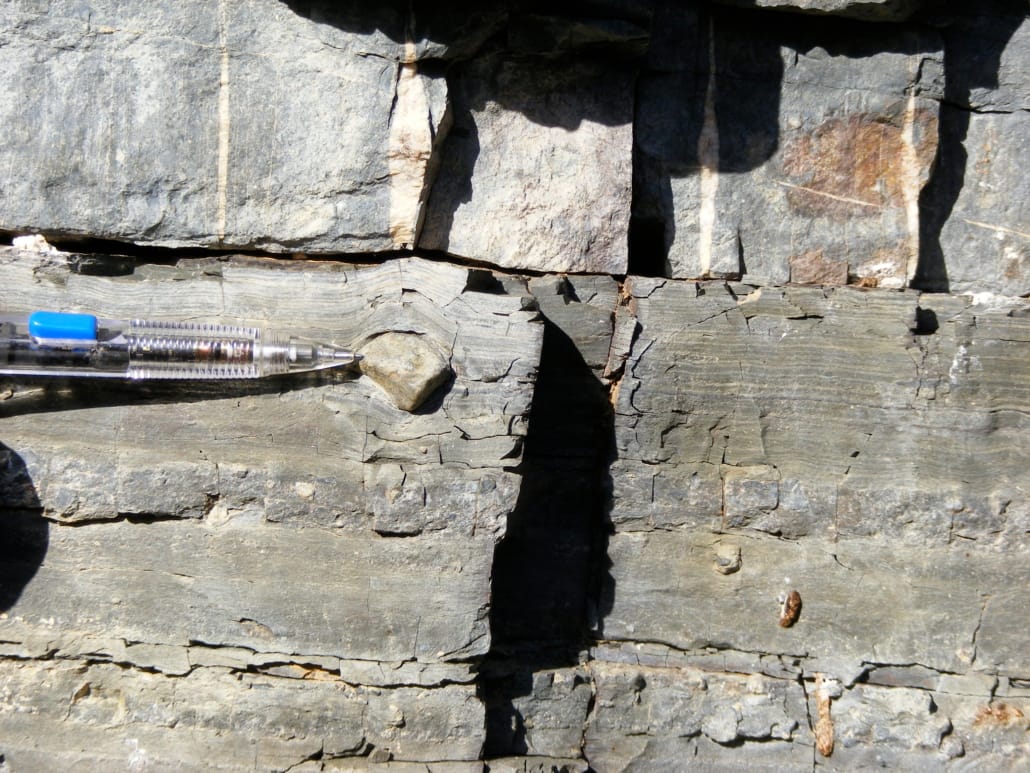
Greenish laminated siltstones of the Elandsvlei Fm, Dwyka Group, near Laingsburg, RSA, containing a solitary pebble which was apparently a dropstone, with thinned laminae draped over the top. Source.
Eruptive Cycles
The prolonged subsidence of the region resulted in several brief and widely separated periods of eruption. The first of these, closely following the glaciation, produced andesitic lavas and tuffs—the Ongeluk Volcanics of the Transvaal and Griqualand West, the flows being in part sub-aqueous, as pointed to by the occasional development of “pillow structures” with chert filling in the interstices between the pillows, exactly as the Palæozoic radiolarian cherts behave in other countries. The two subsequent occasions gave rise to the Machadodorp Tuffs and the Dullstroom Lavas, both on the eastern side of the Transvaal only. These periods of eruption indicate the presence within the crust of a reservoir of magma, which under differentiation provided the basic and acid fractions that subsequently invaded the area.
The period of comparative quiescence, exemplified by an erosion of unknown length and by subsidence over the Central Transvaal—displayed in the Rooiberg Quartzites—was terminated by renewed magmatic activity, of an intense kind, leading to the eruption of predominantly acid lavas, the Rooiberg Felsites, over a territory embraced between Belfast and the Crocodile River in one direction and Bethal and the northern edge of the Palala Plateau in the other. Their manner of effusion is unknown, though the patch of felsitic breccias on the Crocodile River south of Vliege Poort would suggest one possible centre of eruption. In places so great seems to have been the thickness of the sheet of molten matter poured out on the surface that, weighed down by the overlying portion, the basal part was forced to consolidate not as compact felsite but as a coarse-grained granophyre. Speculation prompts us to regard the felsitic matter as the upper, differentiated fraction of the body of basic magma that was about to invade, or was already in course of invading, the underlying Transvaal System.
On the cessation of these eruptions sedimentation was re-established and quartzites and red and purple shales, sandstones, and conglomerates were able to accumulate in a gentle hollow occupying the centre of the Transvaal. Of significance is the facies of this sedimentation, almost identical with that which characterised the Waterberg Beds laid down later, after the introduction and partial erosion of the Bushveld Lopolith.

The Ongeluk Volcanic Beds. It seems not unlikely that these effusions were subaqueously erupted, for along the Mashowing and Kuruman Rivers some of the lava flows exhibit “pillow-like” structures.
The Bushveld Igneous Complex
To such an extent did the internal forces increase after this period, that ultimately Southern Rhodesia was split almost from north to south by a gigantic fissure filled from below with basic magma, while not improbably large volumes of molten matter were poured out at the surface of which erosion has left no traces. During its cooling the magma became differentiated into a variety of plutonic types of varying degrees of basicity, the whole forming the intrusion known as the Great Dyke.
The basic magma-fraction was introduced into the heart of the Transvaal more or less along the plane of contact between the Pretoria and Rooiberg Series to crystallise as an immense cake of norite not improbably as a true laccolith with flattish base and faintly convex top, while the strata beneath chiefly the Pretoria Series—became injected with a host of rudely concordant sills of diabase, under the combined influence of which the invaded sediments became intensely metamorphosed. During its slow cooling this body became differentiated into types ranging from ultra-basic to acid, at the same time acquiring a stratified character through the growth of layers of rock rich in olivine, pyroxenes, titaniferous magnetite, chromite, or plagioclase. The emplacement of this huge volume of matter could not have been the result of a single act, but must have been a long-continued and probably rhythmic process, during which time the composition of the magma suffered progressive changes.
The rising of the lighter acid fraction led to instability of the cover and to crustal collapse, and this magma, bursting through the floor, enveloped and floated-up enormous blocks of the lighter rocks and spread out widely to form the immense sheet of the Red Granite, generally just above the Norite, thereby converting the laccolith into a lopolith with concave structure. Various pneumatolytic mineral deposits were formed close to or within the roof, those carrying tin being the most important, while further hornfelsing was produced in the Pretoria Beds below.
Around the Bushveld Lopolith minor masses were intruded, while to the south, in the Vredefort-Parys region, the subterranean pressure manifested itself in pushing up the thick crust into an extraordinary dome, which ultimately deformed under its own weight, producing overturning, fracturing, and intense metamorphism of some of the strata. There are reasons for supposing that this was the expiring effort of the Bushveld Magma and that it lagged behind rather than coincided with the phase of activity displayed in the main Bushveld Basin.

Vredefort Dome (now confirmed as an impact structure). https://en.wikipedia.org/wiki/Vredefort_impact_structure
The Waterberg-Matsap Transgression
Following, but perhaps also accompanying the cooling of the Lopolith, came an extensive planation covering the area, including the Complex, and stretching far into Rhodesia, Bechuanaland, and Griqualand West; upon this surface were then deposited the sediments of the Waterberg, Matsap, and Umkondo Systems. The magnitude of the erosion-interval can be judged from the fact that, although the Waterberg rests in the Middelburg district, without obvious discordance upon the Upper Division of the Rooiberg Series (here forming the roof of the Lopolith), its base outside that region transgresses across the tilted edges of the Complex and of the Transvaal System to repose in the north and west on the Old Granite, a similar unconformable relationship holding for the Umkondo Beds in South-Eastern Rhodesia. In the case of the Matsap Beds the latter rest usually upon the Campbell Rand or Lower Griquatown Series, but in the Ezel Rand on the Ventersdorp rocks and to the west of the Langeberg on the still older Kheis System. The pebbles of the Waterberg conglomerates include red granite, granophyre, diabase, felsite, tourmalinised quartzites, etc., proving the very extensive denudation experienced by the Complex prior to the forming of the Waterberg System.
The latter with its prominent conglomerates, felspathic grits and sandstones and shales of deep red, brown, or purple coloration is very like the Torridonian or the Old Red Sandstone of Scotland, and was evidently laid down in an interior basin under shallow-water conditions, as shown by the false-bedding in the arenaceous rocks and the ripple-markings on the flagstones. The coarse material so frequently present suggests occasional torrential conditions, while the climate may have been sub-arid. Well-rounded grains of quartz occur in many of the Matsap grits. As developed in the Zoutpansberg, the Waterberg formation is more like the Matsap, paler, more quartzitic and less felspathic or conglomeratic, while the facies of the Umkondo with its calcareous horizons points perhaps to deeper water conditions in the north-east.
No undoubted fossils have yet been collected from the Waterberg System. It is not unlikely, however, that the three formations here grouped together are of early Palæozoic age.
During this period there were occasional volcanic outbursts in several parts of the country, showing that magma still lay not far beneath the surface.
Post-Waterberg-Matsap Movements
Revival of crustal activity is demonstrated by folding of the Waterberg along axes trending roughly east-west with strong over-thrusting locally, for example to the north of Rooiberg, at Stavoren, and on the northern side of the Middelburg Basin, which bendings tended to interfere with the regular shape of the main Bushveld Basin. In the Cape the Matsap System was pressed strongly from the west and the gently arcuate fold-mountains of the Langeberg-Koranna Berg and the hills to the west were formed with the strata contorted, over-folded, and overthrust. Towards the south these foldings curve to the south-east and merge with the earlier ones of the Doornberg; towards the north they pass into the Kalahari, curve to the north-east, and are prolonged into the Bushveld region (Fig. 3).

The Post-Waterberg Eruptions
Doubtless connected with those crustal stresses (though whether preceding or following the folding is not yet clear) was the recrudescence of magmatic activity that culminated in the bursting up of matter of alkaline composition at a number of points in and around the Bushveld Complex. Chief of these occurrences was the huge vent of the Pilansberg with its lava accumulations and remarkable plutonic network, its closing phase marked by the seaming of the greater part of the area by the Bushveld Dyke System of basic and intermediate rocks, many of the intrusions being of alkaline character. The evidence is very strong that the alkalic composition of the prevailing magma at this time was developed by reaction in depth between injected masses of normal basic matter and the Dolomite formation. The eruptions represent an expiring phase of volcanicity, the interior of South Africa remaining thereafter quiescent until the close of the Triassic.
The Cape Transgression
The evidence that the Table Mountain Series is a formation distinct and younger than the Matsap—and consequently than the Waterberg Series—has been set forth earlier. Over the southern half of the Cape before the close of the Silurian a peneplain had been developed from Van Rhynsdorp to Natal with hilly ground still remaining in Zululand and with sundry outstanding ranges in the Transvaal and Griqualand West. Presumably this surface sloped southwards towards an ocean that lay some distance farther away in that direction, though beyond the limits of the present continent. At least one of the river-systems discharging into this southern ocean has been made out in the pre-Karroo “Kaap Valley” traceable from Vryburg to Hopetown, while fragments of others have been detected between Natal and Swaziland. As shown by the nature of the pebbles in the Table Mountain Sandstone and by the coarsening of the three members of the Cape System when traced towards the north, the northern area provided the bulk of the sediments for the building up of the Cape rocks, and certain facts suggest that the Matsap Series also contributed. Indeed, it would only be reasonable to surmise that the post-Waterberg-Matsap earth movements should by ridging up the area in the north have provided the mountain-land whence rock-waste could be carried to form the Devonian strata in the south.
It has furthermore been deduced that South Africa already formed part of that continent well known in later times as “Gondwanaland,” its union with the other land-masses in the Southern Hemisphere being constituted by “land bridges,” unless, following the “Displacement Hypothesis” (Fig. 1), the several elements are to be regarded as having been geographically closer together in those times.

With the gradual depression in the early Devonian of the southern peneplaned border of this continental mass, unfossiliferous white quartzose sands were laid down in great deltas; thus were formed apparently the Table Mountain Sandstone of South Africa, the similar formations of the Falkland Is., Argentina and Uruguay, and the Furnas Sandstone of Southern Brazil. The climate was evidently sub-temperate or even cold, as the glacial horizon in the south-west of the Cape suggests.
Continued sinking within an east-west trending geosyncline brought about a marine (Devonian) incursion with deposition of shallow, cool-water sediments, indicated by the Bokkeveld Series of the Cape and its equivalent representatives in the Falkland Is. and South America, the fossils of which all display that faunal aspect of the Devonian known as “austral.” The lacustrine phase of the Witteberg Series with its scanty flora and eurypterid life has its counterpart in the Falklands and is just distinguishable in Argentina. Not improbably there was at this time a rising of the land to the north, the Series being absent to the north of the Doorn River in the Cape and over south-eastern Brazil as well.
The Carboniferous Geography
So far as this can be reconstructed, the land just before the onset of the Carboniferous refrigeration, as manifested in the Dwyka Conglomerate, was constituted somewhat as follows. 1 Over the bulk of South-West Africa, the Cape, Free State, and Natal the land stood low, probably not very high above sea-level, the elevated ground being concentrated in (1) the Windhoek highlands, (2) the Griqualand West block, and (3) the Transvaal. These masses must have stood higher relatively to the territory immediately surrounding them than now, since they must have suffered reduction in their relative heights through glacial erosion; possibly few ridges exceeded 5000 feet above the level of the sea. South of latitude 33S stretched a body of fresh water or perhaps a wide shallow estuary, while the Carboniferous ocean holding sway much farther to the south appears to have sent an arm to the west of the Cape in a northerly direction, which at the close of the Dwyka glaciation inundated the area of the Fish River Valley in South-West Africa. To the north over Ovampoland, the Northern Kalahari, Southern Rhodesia and beyond there extended land of a gently undulating nature. Finally, the continent must have extended far to the west and also to the east, thereby linking up with South America, Madagascar, and India. The Dwyka Glaciation.—It can be assumed that, as the temperature fell, ice commenced accumulating on the highland areas and that these growing ice-caps spread over the lower lying ground until they merged. The ice appears to have collected more particularly in South-West Africa, the Transvaal, and an area situated east of Natal with Griqualand West as a subordinate centre (Fig. 35), and the corresponding ice-sheets seemingly attained their maxima in order from west to east, ultimately coalescing and presumably forming an ice-front that discharged into the body of fresh water to the south, perhaps after the manner of the Great Barrier Ice of the Antarctic. Under some such conditions as those here pictured was the boulder-bed of the Dwyka formed, having everywhere the characters of a ground-moraine, except in the extreme south, where the ice-sheet was probably buoyed up, though succeeded in particular areas by glacial muds with boulders dropped into either salt or fresh water and sometimes by fluvio-glacial sands and gravels. The parallelism with the glaciation of the Pleistocene is extraordinarily perfect. With the passing of frigid conditions the ice of the western centre dwindled and allowed the Carboniferous ocean to invade the region from the west, whereas the Transvaal and Extra-Natal masses vanished later. A body of fairly deep water followed up the retreating front in a north-easterly direction, within which the Upper Dwyka Shales—mainly glacial silts—were deposited, while the hilly ground of the Transvaal with its uneven covering of morainic matter remained exposed to subsequent erosion for a lengthy period, since it was not buried beneath younger deposits (Ecca) until well in the Permian and in places not until the late Triassic (Stormberg). This extensive glaciation, that in Southern Africa affected not only the region enclosed between parallels 22° and 34° and meridians 17° and 32°, but Angola and Eastern Congo, to just across the equator, was furthermore not confined to this continent, having also been developed in the Falkland Is., Argentina, Uruguay, Southern Brazil, Madagascar, India, Australia, and Tasmania, though whether these various sections of Gondwanaland were ever linked to one another by a continuous girdle of ice during the optimum of glaciation must remain a subject for speculation. Despite the intensity of the climatic changes at this period, crustal movements were of small magnitude in South Africa, consisting mainly of moderate upheaval or subsidence along broad zones of country, while volcanism remained dormant.

“Post-Glacial” Changes
While subsidence was in progress in the Cape and Natal, a ridging up must have been instituted during the Permian in the region farther to the south and east—within what is now the Indian Ocean—and in the trough thus constituted the Karroo Beds of the Cape and Natal were accumulated. The land lying to the south and east furnished the bulk of the sediments, as shown by the coarser nature and greater thickness of the latter in those directions, while a lesser proportion seems to have been contributed by the northern parts of the Union, where the strata concerned have but a fraction of the thickness of those in the south and east, and where the succession is moreover characterised by one or more stratigraphical gaps marking temporary cessations of deposition, probably contemporaneous erosions as well.
Over nearly all the “Southern region” the conditions were lacustrine to start with, but through its filling up this trough must have been converted into a great flood-plain dotted with temporary lakelets and traversed by broad ill-defined flood channels, the climate doubtless varying between cool and humid and warm and semi-arid in different parts. At more than one stage the conditions were such that seams of coal were formed, principally, however, in the east and north-east.
Karroo Conditions
While the area concerned is actually very great in South Africa, it is probably more than doubled when the Congo and East African regions are included; but this becomes enormously increased when the contemporaneous deposits of the other sections of Gondwanaland are also considered. Over such vast territories physiographical and geological conditions must have varied tremendously from point to point, wherefore it becomes particularly difficult to form a rational picture of the manner in which the beds were laid down as a whole, marked as they are by a poverty of fossils and almost total absence of marine forms. A lacustrine origin for the entire accumulation, as commonly imagined years ago, is manifestly out of the question, though certain groups of beds of no small lateral extent appear to have been laid down in still-water, for example the Upper Dwyka shales and the shaly base of the Ecca Series. In this case north-westerly and north-easterly limits were set by the Windhoek highlands and by the more elevated ground of the Transvaal, on approaching which the fine-grained lacustrine muds passed into deltaic deposits.
Despite the intensity of post-Karroo erosion, some of the main hollows within which sedimentation went on can be made out; along their centres only the lower zones are represented, while, as the troughs filled up, the higher horizons were forced to overlap on to the older rocks forming the margins. This applies to the “Northern region” particularly.
Most of the difficulties experienced in trying to picture the conditions over the huge area generally have arisen out of ignorance of the important lateral changes in facies manifested by every subdivision of the System when traced over a large area. Such is particularly well illustrated by the Ecca Series, the variation in character of which is of much importance in the economic geology of this country.
Phases of the Ecca
The principal lithological differences between the Northern and Southern Ecca, as detailed in Chap. XI, are summarised in the following comparative table, which brings out the radically dissimilar conditions under which the two types must have accumulated.
| Northern Ecca or Coal Measures (and also the Molteno Beds) |
Southern Ecca (and the Beaufort Beds) |
|---|---|
| Climate, cool and humid. | Climate, temperate to warm and semi-arid. |
| Coarse grits and arkoses with fresh felspar, pebbles, and occasional conglomerates. | Medium to fine, felspathic sandstones with felspar more or less decomposed; no pebbles. |
| Grey, yellow, or white. | Yellowish, often blue or greenish. |
| Cross-bedded, generally from one direction. | Frequent irregularities in bedding. |
| Individual beds traceable over long distances. | Individual beds with not too wide an extension. |
| Softer strata shaly, though often “sandy,” but clearly differentiated from the sandstones and usually well laminated, frequently micaceous. “Worm-burrows” not uncommon. |
Softer strata mainly of the “mudstone” type even when sandy, ill-differentiated, and poorly laminated. “Worm-burrows” usually absent. |
| Dark blue, grey, or black. | Blue, green, yellow, lilac, purple, or red, often mottled. |
| Calcareous nodules or bands absent; pyritic nodules common in the sandstones—often oxidised. | Calcareous and dolomitic bands and concretions common both in the mudstones and sandstones. |
| Seams of coal, torbanite and fireclay. | No coals or fireclays. |
| Silicified wood absent from Ecca but present in Molteno; plant stems common in sandstones and leaves in the shales. |
Silicified wood common; plant impressions not abundant. |
| No vertebrate remains. | Reptiles, amphibians, and fishes common. |
| Mollusca very rare. | Mollusca not infrequent. |
| Deltaic and fluviatile in origin. | Lacustrine, “basin,” and æolian in origin. |
Physiography of the Ecca
Guided by the above, the history during this period can be interpreted somewhat as follows: In the south of the Cape, after the lowest beds of the “Green Ecca” (mainly lacustrine shales) had been laid down, the water area was encroached upon from the south by sediments of less fine a grain, and from thence onwards right through the Beaufort this appears to have been a tract of varying width alternately just submerged or just exposed to the air, whereon sandy muds, alternating with fine wind-borne sands (probably largely rearranged by water) were deposited. Frequently the silts were dried out and oxidised, while the excess of calcareous matter collected to form nodules.
Following the lower shales in the east and north-east, gravels, sands, and muds derived from the higher ground in this quarter commenced to be deposited in the valleys bordering the “lake,” and by gradual extension southwards and westwards produced a series of flats merging with the “playa” or “basin” of the Cape. Instead of the succession of ill-bedded material ranging from rather bright-coloured muds to fine sands, one finds throughout Natal, the northern Free State, and the Transvaal a well-marked alteration of stratified shaly beds—often carbonaceous—and coarse grits and pebbly sandstones; the fairly constant dip of the planes of false-bedding in Natal indicate an eastern and south-eastern source for these sheets of coarse sandstones.
Vegetation, growing out into swamps bordering the high ground, gave rise to beds of coal, and, as the shallow valleys became silted up, the environment favourable for coal-formation was transferred farther back into the higher ground, so that the succeeding seams overlapped those previously formed, a relationship well seen for example in the Witbank Coalfield.
Over much of the Transvaal, throughout Rhodesia and along the Zambezi these Middle Ecca Coal Measures were laid down directly on the floors of the depressions of an ancient land surface. In the extreme north torrential conglomerates mark their base, and speaking generally the precise conditions for coal-formation were not properly attained until a somewhat later date.
In Gordonia and South-West Africa the estuarine Dwyka shales pass up into the “Red Ecca,” a totally different facies, characterised by red and green shales and mudstones and peculiar brown calcareous sandstones, followed by some thick bodies of reddish or yellow sandstones, the mode of accumulation of which is not properly understood. No seams of coal worth considering have as yet been discovered in these strata.

Outcrop photographs of (A) volcanic tuffs in the lower Ecca Group (Collingham Formation; tuffs marked with yellow arrows), (B) turbidites within the Ecca Group in the Laingsburg subbasin; and (C) chevron folds in quartzites within the Cape fold belt. Scales are approximate on B and C. https://doi.org/10.1130/2018.2540(29)
The Late Ecca Submergence
Through sinking in the north-east and north lacustrine conditions were established over much of this northern region-even in Southern Rhodesia and Nyasaland-and the Upper Ecca shales were now laid down. Their deep-water origin is indicated by their fineness in grain, even stratification, uniform dark blue or blackish colour, by phosphatic nodules carrying fish remains (in Natal) and by the absence of plants and reptiles. During the slow drowning of the old land-surface lying to the north, conditions favourable to the forming of coal would have been progressively formed and destroyed, wherefore the alterations of shale and coal towards the base of this Shale group in the region extending from the Waterberg northwards, so that in Rhodesia and Nyasaland these coals constitute the main workable seams.
The constant association of the coals within shales, their interlamination with and passage into shaly layers, their microscopic structure, the absence of fireclays, and the fragmentary nature of the plant remains all point to these northern seams being “drift coals,” whereas those of the Middle Ecca were mostly formed in situ. It should also be observed that during the early Beaufort the particular conditions determining coal-formation were reproduced in Natal and Zululand.
The Beaufort Series
At the close of the Ecca the peculiar geographic conditions that were prevailing in the Karroo region became extended farther towards the north-east, passing, however, along the southern margin of the Transvaal into a distinct facies very like that of the Ecca Coal Measures in that the sandstones become gritty and have occasional pebbles, while the shales are laminated and associated with thin coals.
In the Karroo itself many features collectively point to there having been periods of desiccation followed by times of flooding during the deposition of the Beaufort-for instance, the many local unconformities and wash-outs, the presence of bands of clay-pellet and sometimes of limestone-pellet conglomerate with fragments of bone at the base of the sandstone bands, the occurrence of red, purple, and green poorly-stratified mudstones, the frequent calcareous concretions, the scarcity of plants. The fact that reptilian remains are fairly plentiful in the west and south, and that the only forms from the Ecca Series should have been obtained in the south-west becomes very suggestive, intimating that the surface must generally have been dry enough for the vertebrates to move about freely. Many of the Pareiasaurians must have died in the exact positions in which they have been found, and presumably their bodies became rapidly covered up by dust or drifted sand; otherwise the bones occur scattered over limited patches of ground. The development of temporary lakelets or “vleis” during this period is disclosed by the occasional finds of shaly layers containing fish remains, freshwater lamellibranchs or crustacea. During the Middle and Upper Beaufort the conditions changed to this extent that the finer silts were of a deep red, purple, or bluish-green colour, often variegated, with calcareous concretions; no changes are, however, indicated by the nature of the life preserved.
The Beaufort Series of the Union and its subdivisions thin in a northerly direction and are not represented north of Amersfoort in the south-eastern Transvaal, though extending through northern Zululand. It reappears to the north of Bulawayo, where in the trough of the Zambezi from Wankie north-eastwards are to be found the dark or coloured Madumabisa shales and mudstones with calcareous concretions and ironstone nodules, along with some thin sandstones; they have yielded a few reptilian, fish, and molluscan remains. The Series is also present in Nyasaland, having in places a distinctly calcareous facies.
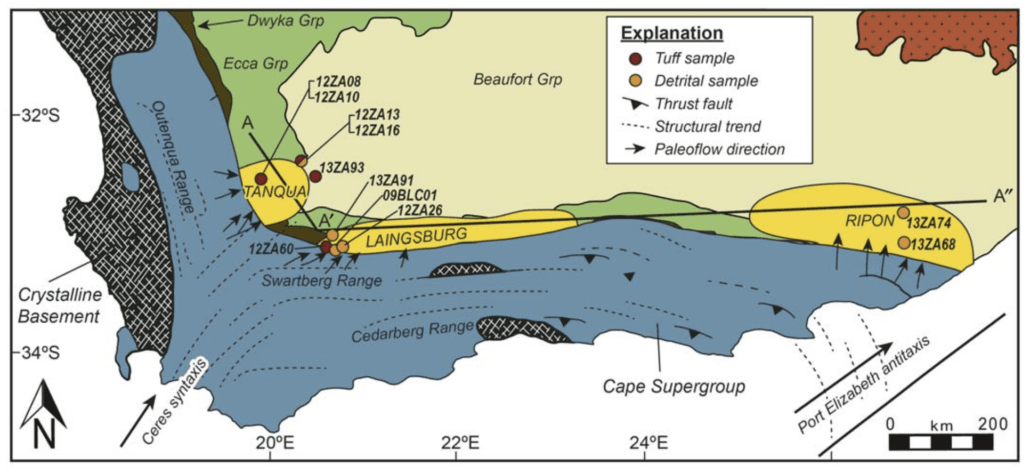
Geologic map of South Africa (after Booth, 2011; Catuneanu et al., 2002) showing the relationship between structural elements of the Cape fold belt and turbidite subbasins (shown in yellow) in the Karoo Supergroup, with sample localities identifi ed. Arrows indicate paleoflow directions (after Catuneanu et al., 2002). Grp—Group. https://doi.org/10.1130/2018.2540(29)
The Stormberg Overlap
Earth movements were initiated over the southern end of the continent towards the close of the Permian developing into the “Zwartberg Foldings” with roughly east-west axes and involving Karroo strata up to the Lower Beaufort (Upper Permian) Beds. The middle of the Triassic appears to mark the culmination of this intense compressive movement and the coarse waste shed from the crumpling and rising mass in the south and south-east was carried northwards and spread out in a great “delta fan” over the Stormberg and Basutoland region almost as far as the Transvaal border; so were formed the Molteno Beds.
In the south the Lower Karroo strata must have been denuded off the crests of the rising folds, for boulders of Witteberg quartzites are characteristic of the Molteno grits, becoming more numerous and also larger as the outcrops of the latter are traced towards the south. Indeed, just to the south of the Zuurberg Range the intensity of the erosion was such that towards the close of the Triassic the Bokkeveld slates were being laid bare; probably in the region still farther to the south the pre-Cape granites were exposed and so furnished the felspathic matter for the Molteno and Red Beds sandstones. The conditions at the commencement of the Stormberg epoch appear to have been almost identical with those determining the Ecca Coal Measures (see previous Table), favouring the growth of vegetation and the forming of coal seams, but on the other hand such as to drive away animal life from the region; the rainfall must have been high and the climate cool. A rather similar order of things prevailed in the Zambezi Valley, where the Beaufort Beds in the still-deepening syncline were being covered by the coarse, fluviatile deposits known as the Escarpment Grits, presumably equivalent with the Molteno group. So far as can be judged, only in the south and in the extreme north-west and north-east were sediments being accumulated during the Molteno stage (Upper or Middle Triassic); elsewhere the surface of the continent—including that made by the previously formed Beaufort or older beds—was being actively denuded. Furthermore, such a state of affairs was not confined to this country, since in certain other portions of Gondwanaland at about the middle of the Triassic a break also occurs, proof of a very widespread erosion during this period. Arising out of subsidence and other causes the subsequently formed divisions of the Stormberg Series proceeded to transgress across the much older formations along this erosional feature, for example about Mariental in the north-west, south of the Zuurberg in the Cape, in the Transvaal and southern parts of Rhodesia, and probably also in Zululand. The temperate climate of the south with its ample rainfall gave way to warmer and more arid conditions that extended themselves over the entire country—largely a reversion to those prevailing during the Upper Beaufort—the earth movements died down, and fine-grained sediments of a red and purple hue were deposited far and wide. In the extreme south, however, some coarser material was still being contributed, evinced by the bands of gritty and felspathic sandstones in the Red Beds and also by the greater development of this formation in that quarter. The restoration of former conditions brought about the return of animal life to the region and dinosaurs and animal forms ancestral to the crocodiles and birds roamed the continent. The Late Triassic Desiccation.—The history of the closing stages of the Karroo Epoch makes a fascinating study. The red and purple muds of the Red Beds of the Southern region and the similarly tinted “marls” of the Lebombo, Springbok Flats, Limpopo Valley and probably of the Kaokoveld, and even some of the still-projecting higher ground became buried beneath a widespread covering of pale to reddish sands of extraordinarily even grain; through this mantle the higher parts of the country different areas as the Cave, Bushveld, or Forest Sandstone and which, generally a few hundreds of feet thick, attains to a maximum value in the south of 800 feet.
The aridity that had already showed itself during the period of the Red Beds had now become intense, for the sandstones in the north bear all the characters of desert origin, as betrayed by the marked roundness and worn nature of the grains, the peculiar false-bedding but lack of stratification, and the local secondary silicification among other features. A progressive change is traceable in a southerly direction into the Cave Sandstone, a type that in its great thickness, uniformity, lack of bedding, angularity of grain and the presence of calcareous nodules in the base, recalls the Pleistocene loess of the Northern Hemisphere. One can consequently picture an immense arid territory, comparable in some respects with the Kalahari, within which isolated ridges of the older rocks were in process of becoming buried beneath wind-borne dust. Such a comparison is the more appropriate, when it is remembered that the red aeolian sands of the Kalahari region are underlain in the south-east by pink marls, by sands, etc., rather like the Bushveld marls and those of the Red Beds: facts that point to a repetition of such conditions in the Tertiary. It should be observed too that during this particular epoch desert conditions developed in South-Eastern Brazil and also in parts of Europe; indeed, the study of the literature dealing with the geology of this time suggests that at the close of the Triassic aridity was so widespread as to have been almost universal.
It can consequently be concluded that toward the end of that period South Africa was a vast waste covered by a mantle of fine cream or red sand, its surface crossed at rare intervals by gentle hollows, certain of which have been preserved for our inspection beneath the succeeding lavas. Trunks of silicified wood show that these flats were not treeless, while the life of the time consisted chiefly of dinosaurs and other allied vertebrates.

Clarens Sandstone. Golden Gate National Park, South Afriica. Source.
The Mesozoic Eruptions
A termination to this state of affairs was brought about by the eruption of vast floods of basaltic lavas and, whether we are correct or not in regarding the various known occurrences in South Africa as formerly joined together—the area being so vast—there can be no doubt as to the hugeness of the several tracts over which the erupted matter was locally spread. The region with Basutoland as its centre is 300 miles long, with the strip beneath the Zuurberg Range in the Cape far to the south; the arc of the Lebombo extends through more than eight degrees of latitude; there are the detached areas of the Springbok Flats, Zoutpansberg, Kalahari, Tete, the wide region between Bulawayo and the Victoria Falls, the lavas of Mariental and far to the north-west the presumably equivalent outpourings of the Kaokoveld. Moreover in South America we find the contemporaneous eruptives of Southern Brazil, Uruguay, and Paraguay that cover a truly enormous region, as well as some in Argentina.
So far as is known volcanoes were developed in and played an important rôle only in the Basutoland section, in which the total number of pipes can be estimated at about several hundred, though the majority of them were merely perforations of the earth’s crust from which no lavas issued, nor were true cones built up; they were purely “gaseous” in fact. Presumably the effective eruptions were of the fissure type, the magma repeatedly welling out of cracks in the crust communicating with channels fed from a subterranean reservoir; the feeders are doubtless now indicated by the narrow dykes constituting part of the dolerite network of the Karroo.
The individual flows must have followed one another freely and rapidly, so that the upper surface of each was never subjected to prolonged exposure, and the fact that many can be traced over considerable distances implies a high degree of fluidity. Ash-beds are almost restricted to the Stormberg-Barkly East-Maclear area, that is to say to a region characterised by eruptions of the “central type.” Intercalations of sandstones are to be found not only in the last-mentioned region, but in Rhodesia, Nyasaland, South-West Africa, and perhaps the Transvaal, but always sparingly and invariably in the lowest few hundred feet of the group only. Some of these bands suggest layers of wind-borne dust.
The relationship of the intrusive dolerites to the lavas is an intimate one, but it would seem as though the mass of erupted material at length became so great, that the magma was prevented from reaching the surface and consequently burst its way through the strata beneath in the form of a veritable network. Noteworthy is the uniform petrological characters of the lavas throughout the wide region involved, they being basalts with little or no olivine, or basaltic-andesites, almost habitually showing layers with the peculiar branching vesicles known as “pipe-amygdaloid.” In the Lebombo the basalts are overlain by rhyolites to a great depth, succeeded in turn by basic types; such acid effusives reappear on the Lower Zambezi. Within a wide region—including the Tuli area, the country north of the Zoutpansberg and the northern end of the Lebombo—the basal volcanics are represented by limburgites and alkaline lavas resting on a slightly eroded surface of Bushveld Sandstone and are cut by narrow dolerite or limburgite dykes. From 1000 to over 4000 feet of volcanic rocks have been measured in different places, but in the Lebombo, where they dip eastwards beneath the Cretaceous Beds, the depth is enormous. Granite-Granophyre intrusions mark the Lebombo-Sabi and Erongo-Kaokoveld zones.
The beginning of the Jurassic found South Africa a vast waste of lava plains in process of elevation and doubtless of active dissection along their margins, but by the end of that epoch much of it, not right at the centre but over a belt marginal thereto, had become worn down to a fairly even surface—the “End Jurassic Peneplain.” 1
The Mesozoic Foldings
The Stormberg volcanic and intrusive episode has been connected with the intense compression and upheaval of the southern end of the continent, as manifested in the “Cape foldings,” an activity that was, however, not confined to this country, but reached to South America on the one side and to Tasmania and Antarctica on the other. This leads to the observation that the pear-shaped outline of the southern end of the African Continent appears to have been developed out of the mass of Gondwanaland through flexing and faulting along three successively-formed, intersecting arcs, within each of which a renewal of crustal movement took place at some later date; the outer limits of each belt lies beneath the waters of the ocean (see Fig. 3).
- On the Atlantic side the “Cedarberg Foldings” extend from Van Rhynsdorp in a south-south-easterly direction, sweeping in a regular arc through Clanwilliam to near Caledon. The three components of the Cape System are thrown into anticlines and synclines, gentle in the north, but more pronounced towards the south, where they link up with and become modified by the seemingly later Zwartberg foldings. From the fact that the Witteberg Beds on the Tanqua River show signs of flexing prior to the deposition of the Dwyka tillite, it would follow that the movement was initiated so far back as the Middle Carboniferous, but must have continued into or else been renewed during the Permian and later, since both the Dwyka and Ecca Beds have been involved. The Cedarberg foldings merely follow the previously established zone of compression, wherein the much older Nama Beds suffered crumpling and plutonic invasion. The trend lines are splendidly displayed by the various mountain ranges, chief of which are the lofty Cedarbergen.
- The “Zwartberg Foldings” make a series of roughly concentric arcs concave to the south, though with a general west-east direction, meeting the Cedarberg set almost at right angles (this giving rise to the structure known as a “syntaxis”), and covering the entire south of the Cape to a width of fully a hundred miles. The formations up to the Lower Beaufort are involved in a succession of anticlines and synclines, for the most part asymmetrical and even inverted in certain sections, as though under pressure exerted from the south. While the arches may run regularly for miles, the folds frequently pitch to the east or west, so that the outcrops of a formation zigzag or are arranged en echelon. The intensity is greatest in the centre and south, e.g. Zwartebergen and Zitzikamma, where the beds are highly crumpled, the foldings becoming less acute within the borders of the Karroo, and fading out into gentle undulations before the higher ground in the north made by the flat-lying Beaufort Beds is reached. In the Western Province on the other hand arches have been pushed up trending north-east or north-west owing to the compounding of the Zwartberg and the Cedarberg foldings. Before the close of the Triassic the bulk of the Cape foldings and much of their subsequent erosion had taken place, for to the south of the Zuurberg the presumed Stormberg volcanics repose in a syncline upon the edges of the highly compressed Cape and Dwyka Beds. A renewal of movement occurred, however, during the Cretaceous as will be detailed later.
- “The Natal Foldings” are revealed almost solely in the lengthy monoclinal flexure of the Lebombo by which the entire Karroo System including the basaltic and rhyolitic lavas were given an easterly tilt at angles of from 5° to 45°, more usually at about 12°. It can be followed southwards to the mouth of the Umtata River in Pondoland, shifted at Empangeni, Embotyi and a few other places by diagonal fractures. The preservation of synclinal structures in the Karroo Beds along the coast between Durban and Mount Edgecombe and also at Port Shepstone suggests that this monocline is really the beginning of a series of synclines and anticlines belonging to an arc of folding all but concealed beneath the ocean, one that when continued to the south-west would meet the prolongation of the Cape foldings in another “syntaxis” corresponding to that of the Western Province.
The enormously thick volcanic sequence of the Lebombo was erupted from a remarkable swarm of fissures trending north-south and the monoclinal structure was produced during the middle of the eruptive period, that is to say about the Liassic, and was probably attended and followed by faulting. From the evidence on the Umgazana River near Port St Johns this flexing of the crust continued into the Lower, but had ceased before the Upper Cretaceous.
Lower Cretaceous Sedimentation
By the end of the Jurassic mountain-building in the south had apparently ended and the valleys, no longer under active erosion, were becoming choked with the waste from the slowly rising arches-red conglomerates, soft sandstones, and pink and white clays, forming the freshwater facies of the Uitenhage Series. With the deepening of the main troughs under the renewal of folding and subsidence of the land, the sea entered from the south-east converting them into estuaries and gulfs. These intermontane deposits were probably accumulated under a semi-arid climate, as suggested by their frequent red coloration, the torrential aspect of the conglomerates, the poor stratification of the clays, the presence of gypsum in them, and of salts of sodium and magnesium in the characteristically saline ground-waters. Nearer the coast they pass up into drab estuarine strata and finally into grey or bluish marine beds with a shallow-water fauna of Neocomian age.
In the south of the Cape the record ceases at this stage, but in the coastal region extending northwards from Zululand the ocean impinged, its waters coming to lap the base of the Lebombo Range, from the rocks of which it derived an abundance of waste, coarse conglomerates being well developed to the north of Komati Poort, particularly upon the Limpopo. More to the north-east such strata furnish strong evidence of aridity.
The faunal resemblances of the South African Lower Cretaceous are with those of Moçambique, Madagascar, and India, and do not support the view of any direct connection with the Central or Northern Atlantic via the Cape, since the equivalent formations in Angola possess fossils of the Mediterranean facies.
Mid-Cretaceous Fracturing
Only recently has the scale of the faulting around the southern end of the continent been adequately recognised and evidence been forthcoming to confirm the suspicion that much of it dates to about the middle of the Cretaceous Epoch. In the south of the Cape through a renewal of movement the Uitenhage Beds were tilted, to considerable angles in places. In the Swellendam-Heidelberg basin and in that of Oudtshoorn the dips are almost universally northwards at from 10° to 25°, but near Uniondale Road up to angles of 45°, while between Sapkamma and Cockscomb Stations on the northerly side of the Uitenhage syncline southerly inclinations of up to 50° are to be found.
Such sagging of the strata in the Cretaceous troughs was accompanied or succeeded by intense faulting which generally followed the trend of the Permian corrugations, and was also associated with cross-flexuring, under which a series of “basins” was developed, in each of which the warped Cretaceous Beds came to occupy a hollow bounded on its northern side by a fault with downthrow to the south; the relatively small-scale “fault-pits” of Baviaans Kloof form an excellent illustration.
Some of the fractures are of huge vertical displacement and Rastall’s and Söhnge’s studies of the Worcester Fault with a maximum throw of about two miles indicate that the dislocative movement was a gradual one: that, as the ground rose on the northern side of the fracture, the fault-scarp was actually being denuded and the waste therefrom spread out within the depression forming in the south. It is a normal or tension fault dipping at 70° to 90° to the south. In the east the Lower Cretaceous to the north and south of St Johns has been dislocated, whereas the belt of Upper Cretaceous in Zululand is apparently unaffected by the great Empangeni fault. Furthermore the break between the Senonian and the Albian and Cenomanian stages in that quarter makes it likely that the north-easterly south-westerly directed bending reached its maximum during the Turonian (Mid-Cretaceous), a stage seemingly unrepresented by marine deposits in South Africa.
The arrangement of the fracture lines around the African land mass is quite orderly (Fig. 3). In the south they follow the Cape arcs—but may cut very obliquely across those earlier folds, as to the south of the Zuurberg to produce several steps, the phenomena suggesting the removal of lateral support from the ocean side. Further to the west they curve either to the south-west or north-west in conformity with the earlier diagonal folding in this quarter; but in Clanwilliam and Van Rhynsdorp they run parallel to the Cedarberg, the downthrow also being on the ocean side as a rule. The main trough-faulting in the Kaokoveld is parallel to the coast. The nearly meridional fractures near Nieuwerust, but with displacement in the opposite direction, may perhaps be older; but between Namaqualand and Keetmanshoop we find a region that has suffered from severe post-Dwyka faulting, as displayed in the Kharas Mountains, the dislocations having westerly downthrows and a strike directed north-north-east. Near Gobabis a line of post-Karroo fracturing has been reported by Rimann trending north-east, that on extension would pass through the step-faulted belt along the shore of Lake Ngami, to be continued by the Deka and other dislocations of the Wankie region (cutting the Batoka basalts), by the mid-Zambezi trough and by the Machinga fault-scarp of the Luano Valley beyond.
This is not improbably the most extensive of the Fracture-systems, but equally conspicuous is another line also directed north-eastwards faulting the Karroo Beds in the Waterberg, Zoutpansberg, Sabi and Buzi Valleys and the Urema trough. Between Pondoland and Zululand the fracturing is closely confined to the coastal belt and is mainly trending east or north-east and therefore in general diagonal to the Lebombo monocline and to the present coast. The downthrows are variable in direction, though most frequently to the south or south-east, a peculiarity being the way in which the dips of the strata on opposite sides of the fault-plane disagree in amount, as in the case of “tear faults.”
All this fracturing is thought to have been developed in the final breaking up of Gondwanaland, either through the subsiding beneath the ocean of large portions of that continent, or as the result according to the “Displacement Theory” of the movement bodily of Madagascar in a south-easterly direction away from the mainland with the consequent production of the Moçambique Channel. In the Lower Zambezi Valley, alkaline lavas were erupted at about this time.
The Cretaceous Ocean
Throughout this long period of crustal adjustments the limits of the ocean, curiously, do not appear to have shifted to any large extent, so that during the late Cretaceous its waters are once again found impinging on the south-eastern side of the Union, as testified to by the Senonian of Pondoland and Natal, but just as of old, spreading out farther to the west within Portuguese Territory with the nearly north-south-trending Lebombo Range forming a long, almost straight coastal chain. In the west the southern ocean still had no free communication with the Atlantic, although a gulf was evidently being extended southwards past Angola and the land connection with South America was about to be severed. A progressive deepening of the ocean in the Beira region is shown by the continuous upward passage of the Danian stage into the foraminiferal limestones of the Eocene.
The Kimberlite Eruptions
The host of volcanic pipes—and the “fissures”—dotted about over South Africa, usually in groups, that are filled with those uncommon rocks, kimberlite, melilite-basalt, or siliceous breccia, mark a recrudescence of magmatic activity of an astonishingly widespread character. The fact that kimberlite and melilite-basalt pierce the previously tilted Lower Cretaceous Beds in the Heidelberg district of the Cape, prove them to be later than Middle Cretaceous.
In the United States the diamond-bearing peridotite-breccia of Pike County, Arkansas, has been found to cut Lower Cretaceous, but to be older than Upper Cretaceous strata.
In the absence of more precise evidence, all that can be said is that matter was erupted from a multitude of perforations and fissures tapping an ultrabasic stratum within the crust at some date towards or just after the close of the Cretaceous, at a time when folding and faulting had practically ceased and up and down movements of the crust were alone in progress. It is a matter of observation that the materials erupted during intervals of “plateau uplift” are frequently alkalic in their composition, which is of significance, since the kimberlite suite of rocks, although of ultrabasic composition, nevertheless exhibit alkalic affinities, best displayed by the associated nepheline-basalts. It can be suggested that this unique phase of volcanicity was perhaps related to the upheaval of the interior of the continent coupled with the deepening of the contiguous oceanic basins. The Cretaceo-Tertiary was certainly a period marked out by alkaline and often highly basic lavas in this continent, as is shown by the Cretaceous outpourings of the Lower Zambezi and by the Tertiary ones of Moçambique Territory and of South-West Africa.
The Tertiary Planation and Uplift
From the Jurassic onwards South and Central Africa underwent several cycles of prolonged planation, the most widespread one being that of the late Tertiary. Each was followed by uplift though not of a uniform nature. Within a few hundred miles of the coast, usually, was situated a “hinge-line,” where the upheaval seems to have attained its maximum, the less elevated interior becoming converted into the Kalahari, now girt by blocks of higher ground—the “Upland Regions” of Fig. 2. Into this shallow central depression various drainages were diverted and, aided by a considerable increase of rainfall, clays, sands and even gravels were laid down upon it mainly in the south and west—the Kalahari Beds—that have yielded Chara and Limnæa, forms present in the contemporaneous coastal deposits.

Lines of warping were moreover developed across South Africa running north-east to south-west, e.g. Rhodesia-Kalahari axis, Khomas axis, etc. (Fig. 3), accompanied by minor faulting, which through the medium of the Urema “sunk-lands” can be connected 1 with the series of gigantic crustal dislocations traversing the eastern section of Africa, known as the Great Rift System,” along which fracturing operated down to a very recent date, accompanied by periodic effusions of lavas.
An intense aridity was finally developed over an immense region probably in more than one phase, with the production of silcretes, calcretes, and ferricretes.
The approximate dating of these orogenic and climatic episodes over the interior is indirectly to be got from the extreme south of the Cape. There by about the beginning of the Eocene a peneplaned surface had been well developed in the southern part of the Cape, cut apparently by the waves in those sections nearest the present ocean, as in Bathurst, Alexandria, Bredasdorp, etc., but continued inland to the base of the fronting ranges and prolonged by river erosion up the principal valleys, right into the southern Karroo in fact. This surface stretched eastwards through the coastal part of the Transkei and the region beyond, while to the north of the Cape Peninsula it may just possibly have been continued by the peneplain known at Saldanha Bay, on the Olifant’s River, etc. Upon the submerged section of this gently sloping surface were accumulated the shelly limestones of the Eocene-Miocene Alexandria-Bredasdorp formations and over the plains and flat-bottomed valleys at the back, fluviatile gravels and sands.
Climatic changes brought about intense cementation of these deposits by silica, iron oxide, or carbonate of lime. This was followed during the Mio-Pliocene by an upheaval, which in the south was at least 1400 feet. On the Luderitz coast marine beds, also dating back to the Eocene and Miocene, were similarly uplifted. At Inyaminga the downfaulted Miocene marine strata on the west of the Sheringoma Plateau indicate the comparatively recent date of the crustal movements in that part of Africa.
These three phases involving respectively extensive planation, the spreading out of coarse waste and the cementation of the latter, duplicate the events in the Kalahari. In the final stages of the late Tertiary desiccation vast quantities of aeolian sands invaded not only the extensive Kalahari region but the western parts of the Rhodesias and Transvaal and north of the Cape, blotting out drainage lines, save where periodical floods were able to keep the channels cleared, and converting the interior into an immense sand desert. The orientation of the “fossil dunes,” now fixed by vegetation, does not fit with present wind-directions and suggests a former southerly displacement of the climatic girdles.
The considerable late Tertiary elevation of the continent led to intense erosion, not only of the coastal belts, wherein the rivers have incised deep gorges, e.g. Transkei-Natal, but even around the Kalahari borders, in
places to depths of hundreds of feet, thus producing plateau-scarps capped with limestone, silcrete or sand, as in the Urinanib or the Loale Plateaux. That striking and lengthy feature the Great Escarpment fronting the ocean was thereby fashioned.
Not only was the Cretaceo-Tertiary marked by strong uplifts but by considerable climatic variations. Now, since elevation is primarily effected by erosion working through isostatic adjustment, it may not be extravagant to suppose that part at least of such climatic changes was brought about by those uplifts.
Climatic oscillations continued through the Pleistocene as well, as disclosed by the strata carrying Palaeolithic implements (p. 430). 1
The boundary between Pliocene and Pleistocene is of necessity vague, but may be widely defined by the incoming of Bos, Elephas and Equus
The Extension of the Continental Border
So far as can be judged the withdrawal of the sea at the close of the Pliocene did not halt anywhere near the existing coast-line—at least not for long—but continued its retreat until presumably much, if not the whole, of the “continental shelf” was laid dry. The feature in question, though only a few miles wide on the south-east, is from 30 to 45 miles broad on the Atlantic side, but on the south forms the extensive triangular Agulhas Bank, with its southernmost point almost 150 miles from the present land. More than half its surface is covered by less than 60 fathoms of water, the 120 fathom line defining its outer margin beyond which the ocean floor drops rapidly. The fact that the other continents are similarly bordered suggests that this feature has in the main originated through a general lowering of ocean-level, which has been ascribed, in part if not entirely, to the withdrawal of water from the sea to form the vast ice-caps that developed during the Pleistocene Glacial Period, a fall calculated at not less than between 50 and 55 fathoms; with the melting of this ice the ocean would have returned to its previous level and therefore have drowned the shelf. The former courses of a few of the rivers across this submerged surface have indeed been made out, e.g. that off Saldanha Bay or off the Breede River mouth, while the sunken nature of the coast can be arrived at either indirectly on physiographical grounds or actually from the results of borings in the channels of certain of the larger rivers, e.g. East London and several points in Natal, where a submergence of fully 150 feet is indicated. Submarine canyons like those of the North Atlantic have been detected by echo-soundings off the Umtata River mouth and Zululand coast.
Oscillations of sea-level stand revealed by raised beaches and old sea-caves at various heights (p. 403). Interest attaches to the finding of extinct species of Hippopotamus, Elephant, Mastodon, etc., below marine clays and sands on the Zululand coast, because of the changes of level that they prove in very late Pliocene or in Pleistocene times. The instability of this extremity of Africa is incidentally brought out by the occasional earthquakes that centre around the Waterberg, Zoutpansberg, Koffiefontein, and Vryheid, while a strong quake occurred at the end of 1932 off Cape St Lucia. 3
Evolution of the River Systems
The primitive interior drainages were appreciably influenced by the “Rift Movements,” hence the north-east to south-west trend of the Upper Orange and its tributaries, the Middle Limpopo, Middle Zambezi, etc. The conspicuous sub-parallel rivers flowing south-east and north-west from the Rhodesia-Kalahari axis are manifestly “consequent streams” resulting from upheaval along that line and incidentally antedate the Kalahari Sand. The view that the Okavango originally drained into the Limpopo, though physiographically possible, is not supported by the fossil shells (Rogers) and the Okavango must formerly have joined the Zambezi.
Remarkable is the way in which the rivers in the south of the Cape take their rise beneath and to the south of the main watershed, yet right behind the barrier ranges shutting in the Karroo, which they traverse in huge ravines on their way to the southern ocean. There are grounds for believing that, after the longitudinal (east-west) valleys to the south of the Zwarteberg, Zuurberg, etc., had become deeply filled with Cretaceous deposits, the later Cretaceous cross-foldings diverted these primitive east-west drainages through synclinal depressions in the parting ranges, and with the new north-south courses once established, the rivers—greatly aided in their action by elevation of the continent and the acquisition of steeper gradients—were able to deepen their channels within the ranges of hard Cape rocks. The arrangement of the drainage is a very instructive study, because of the “subsequent” tributaries characteristically developed along belts of weaker strata, frequently synclinal in their structure, whereas the incised “antecedent” north-south rivers pass transversely through the hard anticlinal barrier-ranges; instances of “river piracy” and “stream interference” are numerous, as for example about Uniondale. Behind the barrier the strata have been eroded up to the face of the Great Escarpment, the retreat of which is still in progress.
Onward from the eastern end of the Cape fold-belt the streams originated upon and therefore meandered over the mid-Tertiary peneplain, and their windings, initiated thus far back, are perpetuated in their present deeply eroded and winding channels, as for instance the Great Fish, Great Kei, or Bashee Rivers.
All round the southern end of the continent the recent and quite considerable uplift in the Tertiary Epoch has caused each of the larger rivers to develop cataracts or rapids in some portion of its course; this has been an effective hindrance to navigation and is in marked contrast to the evenly graded channels of the Niger, Nile, or the large water-ways of South America.
The Human Period
Surprisingly little is known of the animal life of the Tertiary, while our knowledge even of the fauna of the Pleistocene is but a scanty one. The forms described from the Miocene of the Lüderitz littoral are chiefly of rodents indicative of “steppe” conditions in that part of the country. The Pleistocene is represented by the mammoths Mastodon, Archidiskodon, and Pilgrimia, by the elephant Loxodonta, by extinct species of giraffe, horse, zebra, and various antelopes and carnivores.
The remains of the astonishing Australopithecus from Taungs, possibly of Pliocene age, and of the probably younger Paranthropus from Krugersdorp are of beings intermediate between the apes and primitive Man, while the renowned Homo rhodesiensis from Broken Hill, North-Eastern Rhodesia, introduces us to a form regarded by Keith as probably the most primitive type of human being yet known. He was followed by “Boskop Man.” There is some excuse, therefore, for the idea that Southern Africa may have formed the “Cradle of Mankind.” On the other hand, while the evolution of stone tools in South Africa corresponds almost stage for stage with that of the Northern Hemisphere, the Palæolithic Industry persisted here into times represented in Europe by the Neolithic, Bronze, and Iron Ages. This suggests that each new stage of lithic industry in its spread through Africa pressed back the older stone cultures into the southern extremity of the continent, which would help to explain the fact that the culture of the Bushman bears the stamp of the Aurignacian period.
A vast and fascinating field of research lies open for investigation, with few workers therein, though fortunately this human aspect of Geology—the real basis of Anthropology—is now receiving a good deal of well-directed attention, which should before long provide a fairly comprehensive picture of Man’s Evolution in Southern Africa.
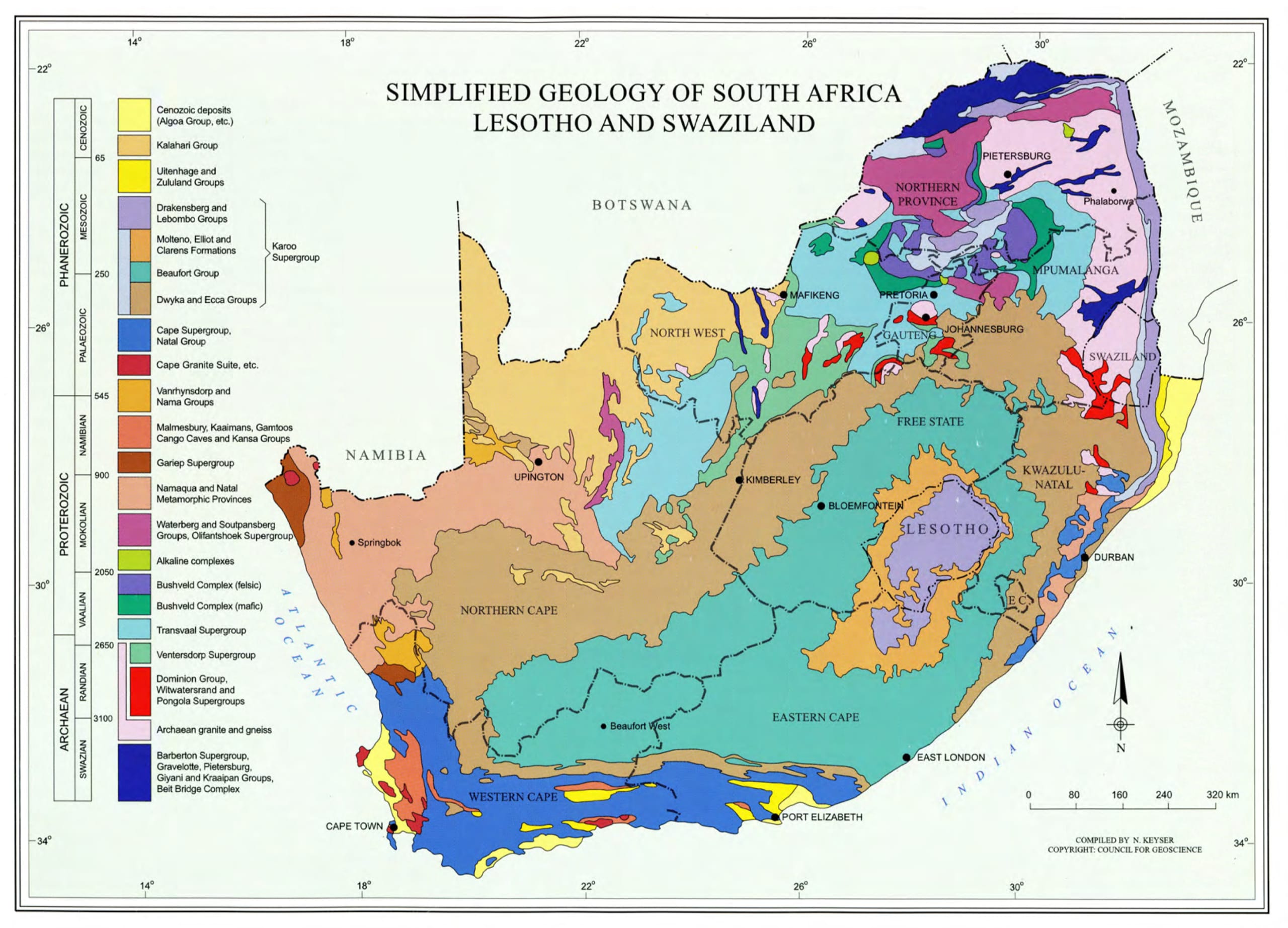

“Two mighty meteors — of sun- and moon-like apparent size and shape — appear threateningly with their accompaniments. The star-world falls into turmoil, and the actual war begins: the Morning Star (Venus) opens it, standing on the back of Leo. Seven months later a new heaven results, as the Sun moves from about mid-Virgo to mid-Aries. The stars that ruled the dawning morning sky plunge at last into Okeanos and set the earth afire. Such is the fundamental thought — recognized only once facts beneath poetry’s veil are laid bare.”
The discovery forced a rewrite of what archaeologists thought they knew about underground construction in the ancient world. Before 1963, the largest known subterranean complexes were the Roman catacombs and the Basilica Cistern in Istanbul. Derinkuyu alone could hold twenty thousand people. Kaymaklı, nine kilometres away, was larger still. The two were probably connected by a tunnel whose ventilation shafts have since been filled with rubble.
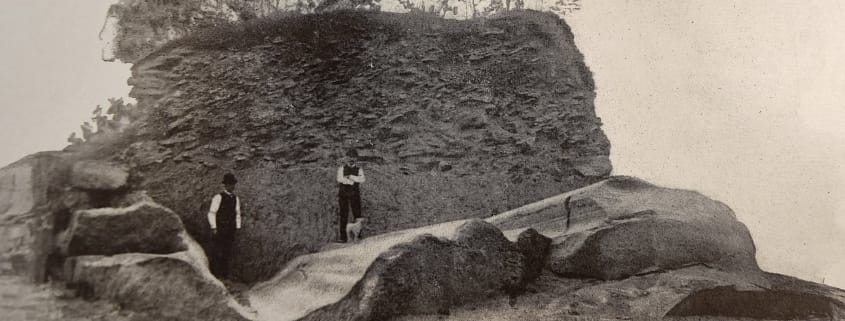
The drift is a remarkable stratum of clay, sand, gravel, and far-from-source boulders seemingly flung by some careless hand over the northern portions of Europe and North America. Some of this debris has been moulded into distinctive ridges (moraines), rounded hills (drumlins), and long sinuous ridges (eskers). Any theory of drift formation must account for these singular accumulations as well as an immense family of scratches, lake basins, and sundry gougings.

The first obstruction to knowledge is often not the world itself, but the human instrument by which the world is received.
A people who saw the sea arrive where no sea belonged would not leave behind a peer-reviewed monograph. They would leave a story. And the descendants of that story would eventually be mocked by men who mistake their own notation for reality.