
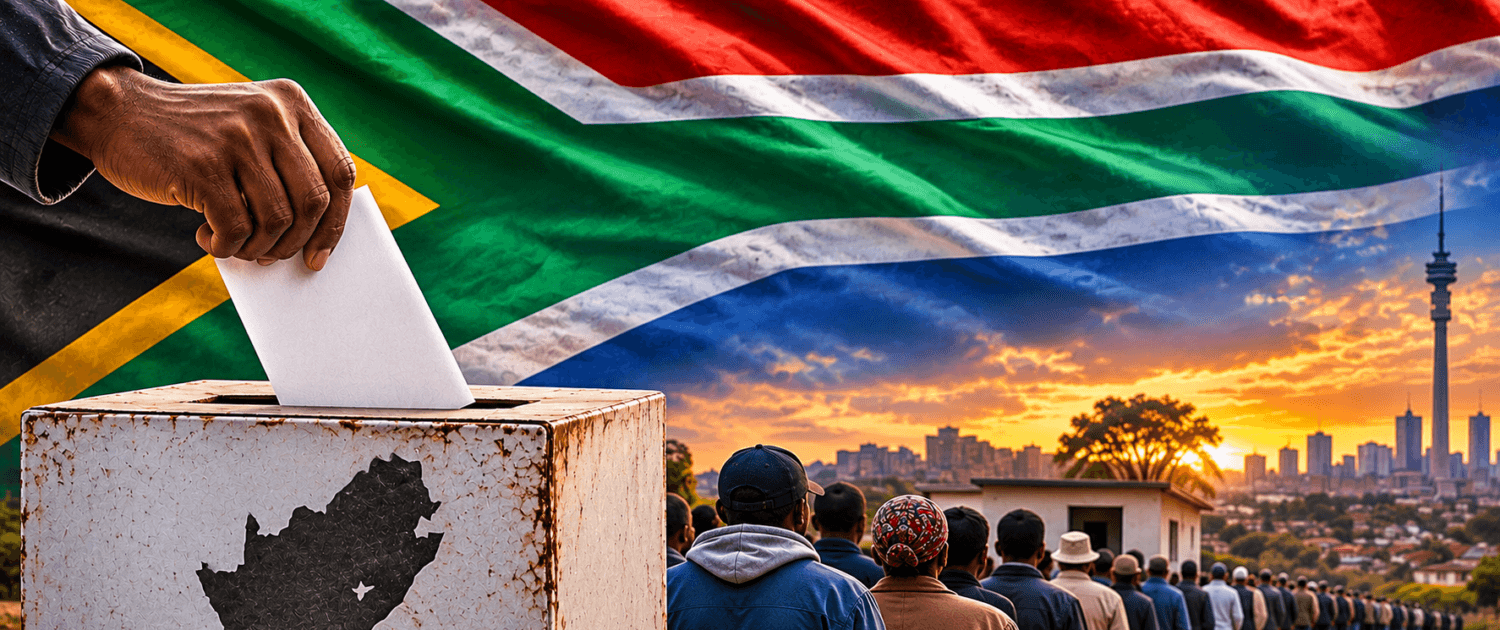
Thirty years after its founding election, the Republic no longer needs most of its people to rule. Participation has collapsed to a minority, state force is both ineffective and unaccountable, political office has become spoils worth killing for, and a narrow donor class funds both the parties and much of the media that keep up appearances.
In May 2024, sixteen-point-three million South Africans voted for a national government. The official turnout figure quoted everywhere was 58.6%. What that number actually measures is the share of registered voters who bothered to show up, and registration itself has been quietly decaying for two decades.
The more honest denominator is the voting-age population: every adult entitled, by law, to have a say. By that measure only about four in ten eligible adults cast a ballot. Six in ten did not. The media never lead with this figure, because everything that follows depends on understanding how small the consenting coalition really is.
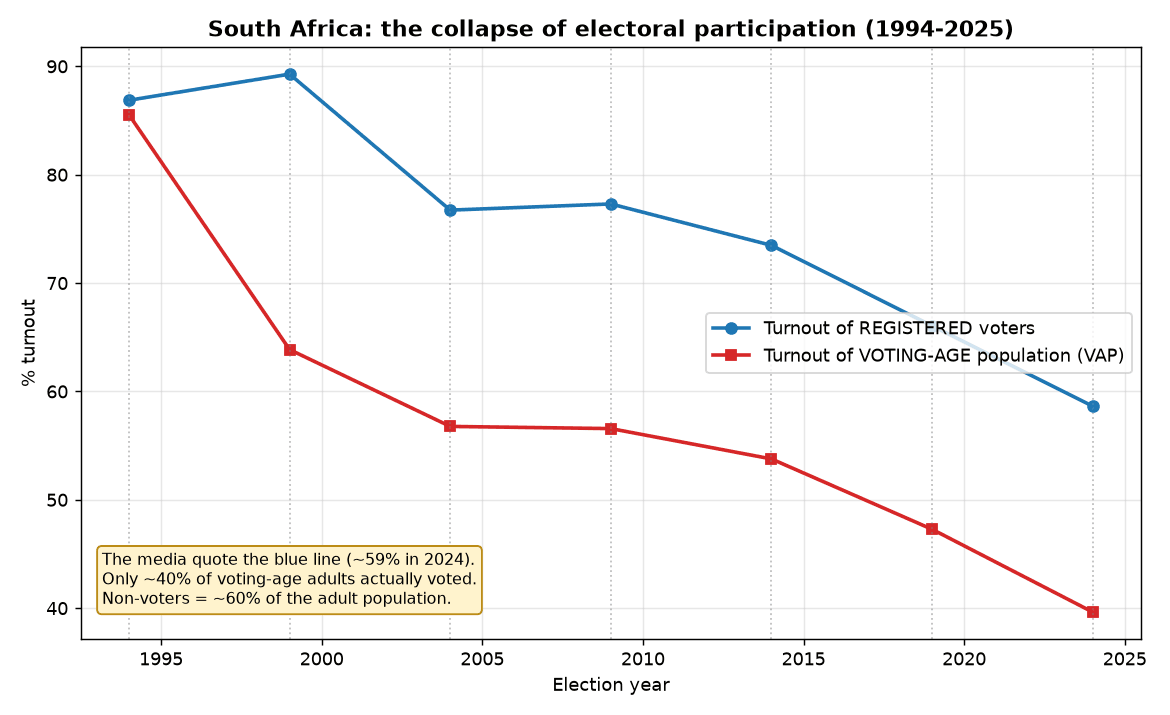
The media quote the blue line (58.6% in 2024). Only ~40% of voting-age adults actually voted. Non-voters are now roughly 60% of the adult population.
This is not a blip or an unusually quiet election. It is the terminal point of a thirty-year decay curve that began at near-universal mobilization:
| Election | Turnout of registered (%) | Turnout of voting-age population (%) |
|---|---|---|
| 1994 | 86.9 | 85.5 |
| 1999 | 89.3 | 63.9 |
| 2004 | 76.7 | 56.8 |
| 2014 | 73.5 | 53.8 |
| 2019 | 66.1 | 47.3 |
| 2024 | 58.6 | 39.6 |
The voting-age-population turnout fell 45.9 percentage points in thirty years. No comparable democracy lost participation at this rate. The decline is overwhelmingly a generational one: only about a quarter of eligible 18–19-year-olds and half of those aged 20–29 even registered, while over nine in ten South Africans past fifty are on the roll.1
The people who no longer participate are precisely the young and the poor – the same people most likely to be policed by the state they have declined to authorize.
Weber’s definition of the state is still used today: an institution claiming a monopoly on legitimate force within its territory.2 The word doing the work is legitimate. A government can wield enormous coercive power; what it cannot do, in principle, is wield it and simultaneously claim it flows from “the will of the people” when a majority of those people have withdrawn from authorizing it.
Sherrer’s Voting Is an Act of Violence, his later Non-Voting as an Act of Secession, Larken Rose and Stefan Molyneux press this to its conclusion: that voting is what launders state force into legitimacy, and abstention is the citizen’s one honest refusal.3 Whatever one makes of that claim in general, South Africa gives it shape. When only four adults in ten choose their rulers, every subsequent exercise of police power against the six who did not rests on consent they never gave.
“The authority for each and every one of the government’s actions is presumed to flow from the consent of the people through the electoral process.” — Hans Sherrer
The young abstainers are not principled secessionists. They did not organize withdrawal; they simply stopped being asked to believe. Their non-participation reads less like Sherrer’s deliberate refusal, and more akin to exhaustion with a promise that failed. And the state they have abandoned does not notice, because, as we are about to see, it no longer needs them.
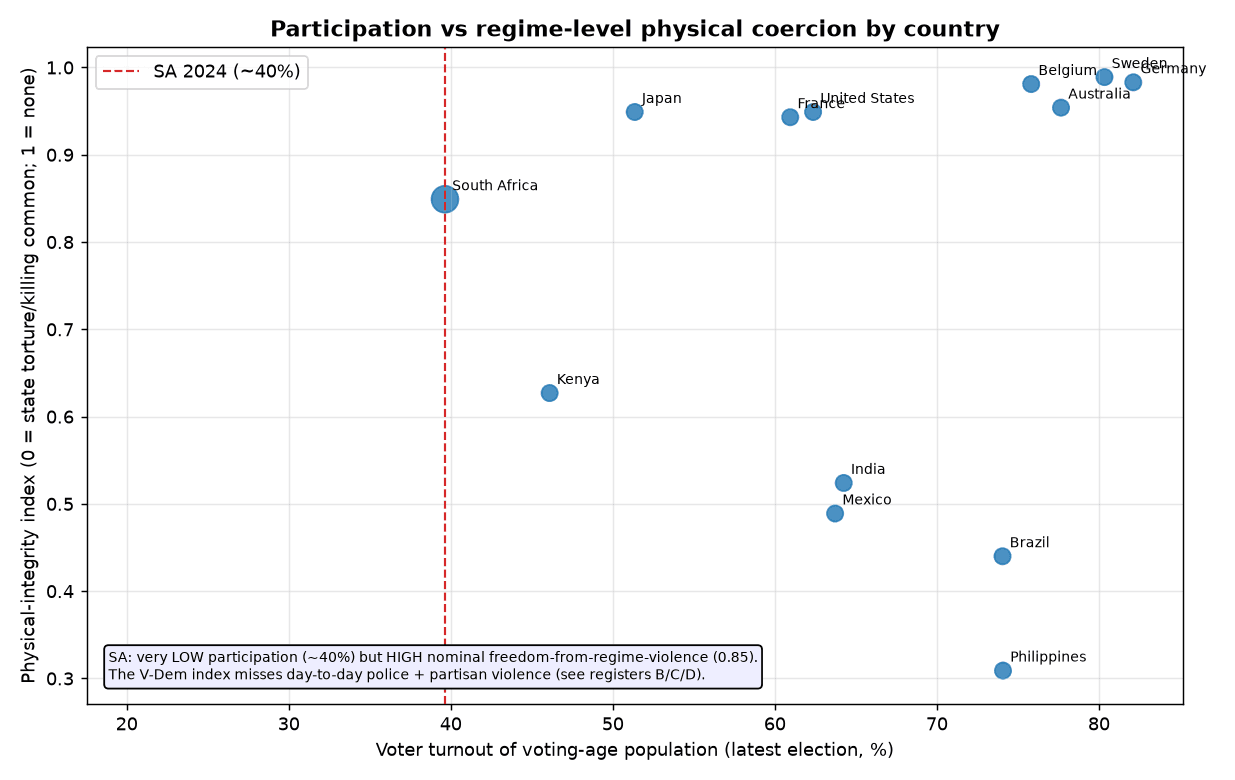
South Africa’s “state violence against civilians” is a category that standard human-rights indices get almost exactly wrong. On the V-Dem physical-integrity scale (freedom from political killings and torture by the government) South Africa scores in the top third of all countries, around 0.85.4 That is because post-apartheid there have been no large-scale regime campaigns of terror. The index measures regime terror, and on that narrow axis, the country looks clean.
The reality at ground level is very different. Described across four registers:
- Regime terror (what the indices measure). V-Dem physical-integrity ~0.85, top-third globally. No mass political-killing campaigns since 1995. This is why standard measures call SA “fine.”
- Police lethality (what citizens actually meet). IPID/SAPS record roughly one person killed by police every day. The per-capita rate is the second-highest in our comparator set – about twenty-five times Germany’s, well above the United States.
- Partisan political violence (the largest direct threat to politics). 488 politically-motivated assassinations between 2000 and 2023. In one five-year window, Parliament logged 59 councillors and 37 municipal officials murdered – overwhelmingly in KwaZulu-Natal, where factional contests for control of councils (and their procurement budgets) turn lethal.
- State-tolerated collective violence. Xenophobic attacks have killed over six hundred people and displaced more than a hundred thousand since 2008, largely unpoliced. The July-2021 unrest claimed ~350 lives amid both state incapacity and vigilante reprisal.
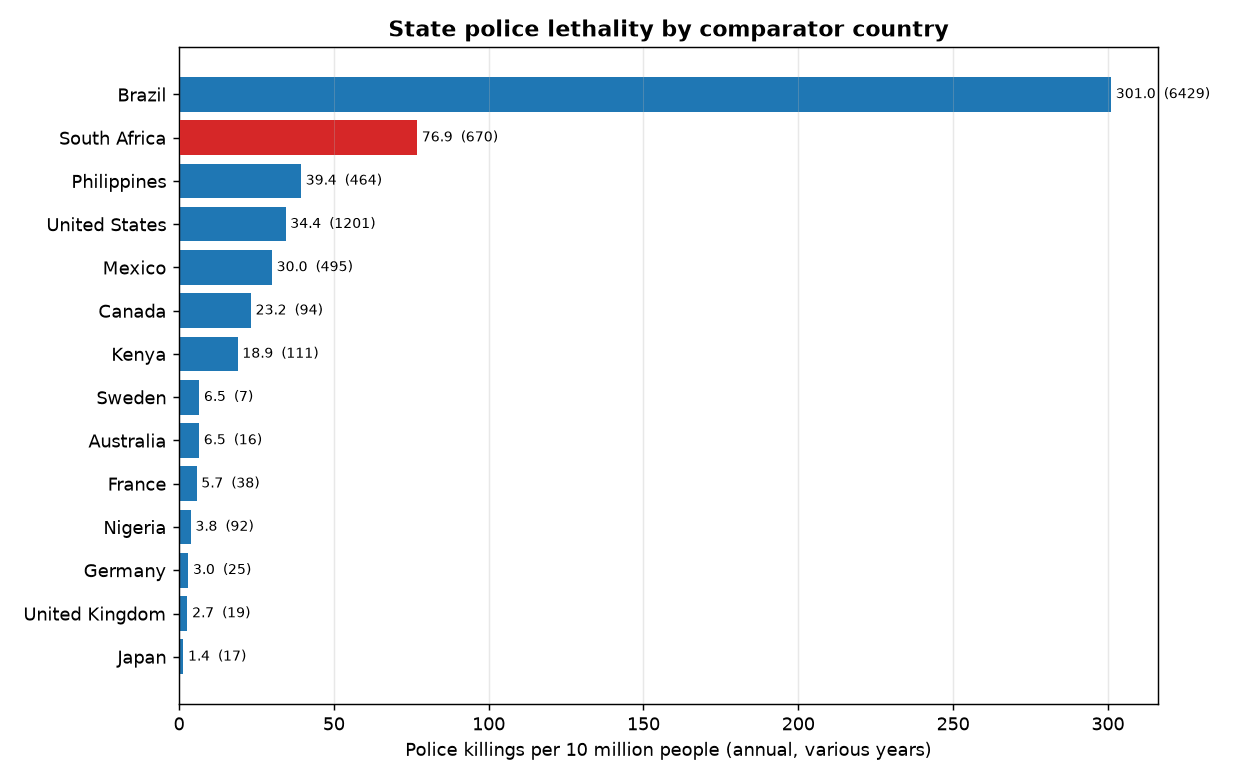
Police lethality per capita, selected countries. South Africa (~77 per 10M) sits second only to Brazil.
Here is the crux that connects coercion back to participation: the state whose force falls on civilians is simultaneously ineffective – barely one in seven murders are solved, violent crime has risen for years – and unaccountable. IPID registered some 75,000 complaints against police between 2012 and 2025. From those came just over four hundred dismissals. About half of one percent.5
A coercive apparatus that can neither protect people nor be held to account is not a malfunctioning instrument of order; it is an instrument of rule. And the citizens on whom it falls are disproportionately the same poor, young, unregistered majority who no longer authorize it.
The single most important finding from assembling this dataset is that South Africa’s partisan political violence does not concentrate where participation collapses. I tested this at province level (nine provinces, IEC participation joined to GI-TOC assassination data and parliamentary records of municipal official/councillor murders).
| Measure (province-level, n=9) | Spearman ρ |
|---|---|
| Councillor murders × turnout | +0.29 |
| Municipal official murders × turnout | +0.59 |
| Political assassinations (2023) × turnout | +0.54 |
The correlations are positive, not negative. The strongest runs against the intuition that violence follows apathy. KwaZulu-Natal has above-average participation (78% registration, 62% turnout) and by far the most targeted political violence: twenty-one councillors and seventeen officials murdered in a five-year window. Gauteng, the province with the lowest registration rate of all, saw comparatively few.
The driver is not participation collapse but contested control of state resources. Office is worth killing for. Whether citizens vote is almost beside the point.
A municipal-level test (8 metropolitan municipalities) was also attempted with ACLED event-geodata, but it proved uninformative: all metros are low-turnout urban units clustered within a five-point band (42–47%), so there is no participation gradient to correlate against coercion. The high coercive-event counts concentrate in the largest metros simply because they hold the most people and political activity.
The people fighting are not the apathetic majority seeking representation; they are a political class and its criminal patrons competing over who will hold the machinery that pays. The collapse in participation happens alongside this – not as its cause, but as its shadow. Citizens stop showing up precisely because they perceive, correctly, that the contest is about spoils, not service.
The question nobody asks when turnout collapses is who profits from a system that no longer needs voters. The answer, in South Africa, is concentrated and documented, because since 2021 the Party Funding Act has forced disclosure.
Two parties captured more than 73% of all party funding. The Democratic Alliance’s largest benefactors are the Oppenheimer family (roughly R60 million spread across opposition parties) and Capitec founder Michiel le Roux, whose Fynbos entities supplied about a third of the DA’s war chest. Martin Moshal (the Betway fortune) funded multiple opposition vehicles at once.6
The governing ANC drew more than half its declared private money from its own trusts (Batho Batho, Chancellor House) and a quarter from mining majors – United Manganese of Kalahari, Harmony Gold, African Rainbow Minerals, the last two linked to billionaire Patrice Motsepe. Naspers gave R2 million each to the ANC and the DA.6
Now add the media layer that your title invites us to notice:
- Naspers owns News24, South Africa’s largest news platform, and donates to both major parties.
- The Oppenheimers, historically through Anglo American’s press holdings, still concentrate political donations while their mining legacy persists.
- Arena Holdings (TimesLIVE, Sunday Times), Sekunjalo/Independent Media, Caxton and the donation-funded Daily Maverick complete a media map whose ownership overlaps the donor class.
The structural point is not conspiracy; it is incentive. When a narrow set of private fortunes and extractive industries funds both the governing party’s machine and much of the journalism that frames its legitimacy, there is no mechanism by which falling participation produces change. The donors’ access and contracts are independent of how many citizens vote. Indeed, an exhausted, atomized electorate is easier to ignore.
Set South Africa against the model now in vogue across the hemisphere and the thesis sharpens by contrast. Nayib Bukele, president of El Salvador: “There is no State that cannot put an end to crime. If a State fails to put an end to crime in its country, it is because criminals are part of the government.”
It is a seductive line. When officials inside Eskom were siphoning billions while load-shedding darkened homes; when municipal office-as-spoils drives assassinations; when police misconduct goes 99% unsanctioned – “criminals are part of the government” is not metaphor.
But El Salvador’s own numbers should make us wary of importing Bukele’s framing wholesale. The homicide decline he claims began before his signature crackdown: rates fell about 50% under his predecessor between 2015 and 2018, from a peak near 105 per 100,000.8
| El Salvador metric | Value |
|---|---|
| Homicide rate peak (2015) | ~105 / 100k |
| Rate before Bukele took office (2018) | ~53 / 100k |
| Claimed rate by 2024 | ~1.9 / 100k |
| State of emergency, Mar 2022 → | suspended constitution; extended 20+ months |
| People arrested (to late-2023) | >77k (>1% of population) |
| Prisoners as share of national population | ~105k ≈ 1.7% |
The decline was achieved via mass detention without due process, torture allegations, and a prison system holding nearly two percent of the country. Analysts note that police killings, prison deaths and discovered remains may be excluded from official homicide tallies, which could inflate the claimed 2023 rate by up to half.9
The uncomfortable parallel is this: El Salvador manufactured acclamation through fear of crime and effective, unaccountable force. South Africa has collapsed into apathy alongside ineffective, unaccountable force. Both are failures of consent. Bukele’s model does not rescue the proposition that “a working system encourages participation”. It shows how coercion can substitute for consent altogether.
The rituals remain in place. Every five years, sixteen million people go to the polls; parties raise and spend hundreds of millions; journalists report turnout “of registered voters”; a government is formed and claims to speak for the nation. Nothing about that sequence requires it to be true.
What holds South Africa together, in truth, is not the consent of forty percent – it is the combination of a state’s residual capacity for coercion, a donor class with no interest in disruption, and an exhausted public that has stopped expecting change. That is not democracy failing occasionally. It is the illusion of consent operating as the real system.
The question posed by six-in-ten silent adults is not how to make them vote again, but whether a republic can long pretend that their silence authorizes what is done in their name.
Method & Data
Every figure above carries provenance. Full machine-readable dataset, method notes and analysis scripts. Download (694 KB zipped)
References
- IEC certified voters’ roll & Stats SA voting-age population projection, May 2024 (39.75M VAP); per-province and age-band registration from IEC / SABC election reporting. Source: IEC 2024 National Ballot Voter Turnout; Daily Maverick, “The big no-vote”.
- Max Weber, Politics as a Vocation, in Gerth & Mills, eds., p.78. Text: Wikipedia (Politics as a Vocation); collected at nobulart.com.
- Hans Sherrer, “Voting Is an Act of Violence” (1999) and “Non-Voting as an Act of Secession” (2001), collected at nobulart.com/the-monopoly-on-violence/.
- V-Dem v2x_clphy physical-integrity index, via Our World in Data (Physical Integrity Rights Index); SA ~0.85 (2025).
- IPID annual reports & Viewfinder Police Accountability Tracker (75,308 cases Apr-2012–Mar-2025; 437 dismissals, 496 imprisonments); Africa Check on police-action deaths; Viewfinder, “Massive database of killings by police”.
- IEC political funding disclosures under the Party Funding Act (effective Apr-2021); MyVoteCounts analysis of IEC annual report FY2023/24; Daily Maverick party-funding graphics, Mar-2024.
- Zondo Commission final reports, handed to President Ramaphosa June-2022; Mail & Guardian estimate; Corruption Watch / Shadow World Investigations testimony (R49bn–R57bn range).
- Congressional Research Service IN12510; InSight Crime, “El Salvador’s Perpetual State of Emergency”; HRW World Report 2024: El Salvador.
- Analysts cited in CRS IN12510 note official tallies may exclude police killings, prison deaths and discovered remains — raising the 2023 rate by up to ~47%.
- Metro turnout figures: IEC ward-level voter-turnout reports (e.g. Johannesburg total 947,305 / 2,220,710 = 42.61%) and GroundUp’s verified metro table (GroundUp, “Metro voters stayed home in 2021”); national LGE2021 turnout 45.86% per IEC National Voter Turnout report.

“Two mighty meteors — of sun- and moon-like apparent size and shape — appear threateningly with their accompaniments. The star-world falls into turmoil, and the actual war begins: the Morning Star (Venus) opens it, standing on the back of Leo. Seven months later a new heaven results, as the Sun moves from about mid-Virgo to mid-Aries. The stars that ruled the dawning morning sky plunge at last into Okeanos and set the earth afire. Such is the fundamental thought — recognized only once facts beneath poetry’s veil are laid bare.”
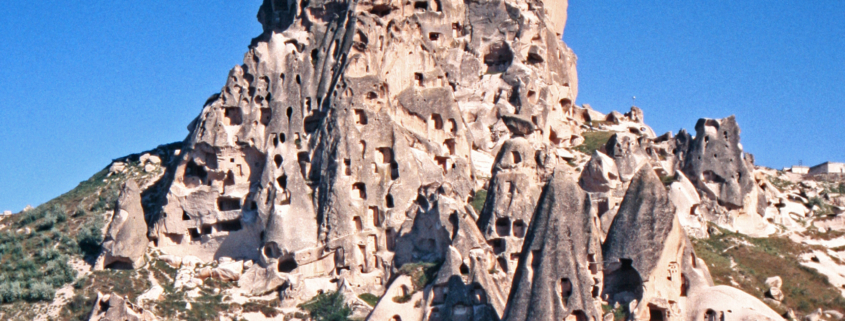
The discovery forced a rewrite of what archaeologists thought they knew about underground construction in the ancient world. Before 1963, the largest known subterranean complexes were the Roman catacombs and the Basilica Cistern in Istanbul. Derinkuyu alone could hold twenty thousand people. Kaymaklı, nine kilometres away, was larger still. The two were probably connected by a tunnel whose ventilation shafts have since been filled with rubble.
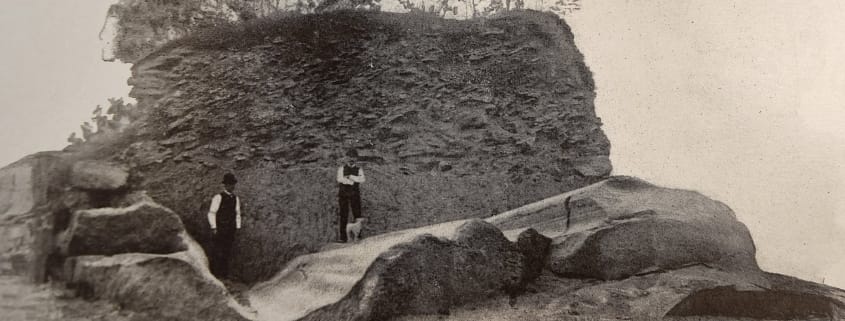
The drift is a remarkable stratum of clay, sand, gravel, and far-from-source boulders seemingly flung by some careless hand over the northern portions of Europe and North America. Some of this debris has been moulded into distinctive ridges (moraines), rounded hills (drumlins), and long sinuous ridges (eskers). Any theory of drift formation must account for these singular accumulations as well as an immense family of scratches, lake basins, and sundry gougings.

“Just as in the case of all other countries, the earliest pages in the Geological Record of South Africa are most fragmentary and utterly confusing; much remains to be done before even the outlines can be reconstructed. It must suffice to remark that at some extremely remote date, possibly more than 1000 million years ago, basic lavas—seemingly the earliest known of the rocks—were being poured out over several large sections of this country, in many places sub-aqueously—probably upon the ocean floor—that they were accompanied and followed by tuffs, slates, limestones, and the remarkable group of the banded ironstones, jaspilites, and cherts, and by quartzites, grits, and conglomerates.”
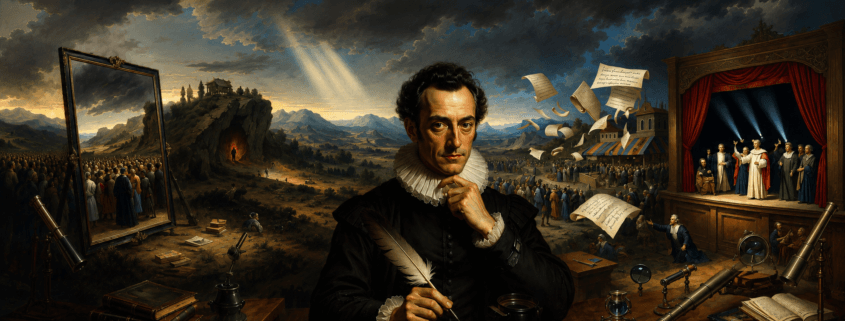
The first obstruction to knowledge is often not the world itself, but the human instrument by which the world is received.

A people who saw the sea arrive where no sea belonged would not leave behind a peer-reviewed monograph. They would leave a story. And the descendants of that story would eventually be mocked by men who mistake their own notation for reality.
